01 Generator size calculator
What size generator do I need?
Pick a situation or build your own list. Your number and verified picks update as you go.
Your generator size
Sized for Essentials in an outage (14 items)
Your generator needs at least
4,200 starting watts
and about 3,300 running watts
Portable fits
A mid-size inverter or small portable generator covers this.
Class: Mid-size inverter (3,000 to 4,500 W) or small portable (2,000 to 4,000 W)
As an Amazon Associate, we earn from qualifying purchases.
Verified picks for this size
WEN DF475T
Covers your 3,300 running and 4,200 starting watts
Has the 240 V L14-30R outlet that a 30 A transfer switch or interlock hookup needs.
3,800 W running · 4,750 W peak · gas or propane · 120/240 V
Find it on Amazon (opens Amazon in a new tab)Westinghouse WGen3600DFc
Covers your 3,300 running and 4,200 starting watts
A 120 V dual fuel portable with an RV-ready TT-30R outlet and a CO sensor shutoff.
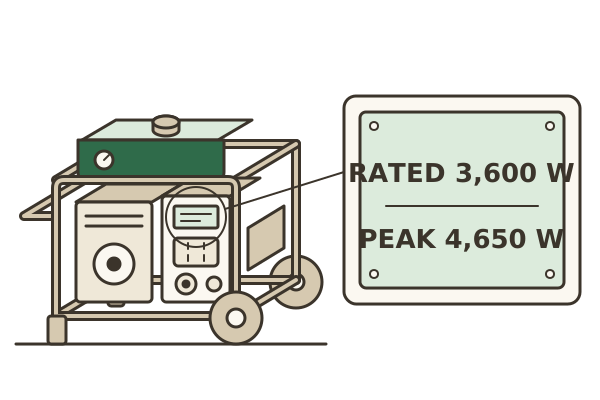
3,600 W running · 4,650 W peak · gas or propane · 120 V only
Find it on Amazon (opens Amazon in a new tab)Westinghouse iGen5000DFc
Covers your 3,300 running and 4,200 starting watts
A dual fuel inverter with an RV TT-30R outlet, 3,900 running watts and a CO sensor.
3,900 W running · 5,000 W peak · gas or propane · 120 V only
Find it on Amazon (opens Amazon in a new tab)
All our verified picks for this size, with specs
On any listing, check two numbers: at least 3,300 running watts and 4,200 starting (peak) watts. Listings often lead with the peak figure.
Check your plugs. Honda’s wattage guide lists furnace fans and sump pumps as 240 V loads. A 240 V load needs a generator with a 120/240 V outlet, and a hard-wired load needs a transfer switch. Each pick lists its outlets.
How to connect it to the house. Run it outside only, at least 20 feet from the house, exhaust pointed away (CPSC).
Show the math
- Running total: 2,700 W
- Largest single starting surge: 720 W (Refrigerator)
- Starting total: 2,700 + 720 = 3,420 W
- Plus 20 percent headroom: 3,240 W running, 4,104 W starting
- Rounded up to the next 100: 3,300 W running, 4,200 W starting
Typical figures from published wattage charts; check your appliance's label. The rule: running total, plus the single largest starting surge, plus 20 percent headroom. Above 3,000 ft or running on propane, size up (see how sizing works).
Your load sheet
14 items on at the same time. Change any row.
| Item | Running W | Starting W | How many | Change |
|---|---|---|---|---|
| RefrigeratorChampion wattage chart | 280 W | 1,000 W | ||
| Furnace blower 1/2 hpChampion wattage chart | 550 W | 1,200 W | ||
| Sump pump 1/3 hpChampion wattage chart | 650 W | 1,300 W | ||
| LED bulbChampion wattage chart | 20 W | 20 W | ||
| Internet router/modemChampion wattage chart | 20 W | 20 W | ||
| Phone chargerChampion wattage chart | 60 W | 60 W | ||
| MicrowaveChampion wattage chart | 900 W | 900 W |
Often on an outage list
02 Wattage chart
Generator wattage chart
Typical running and starting watts for 58 common loads, from published wattage charts (mostly the generator makers' own). Tap Add to put one on your sheet.
Home and backup 29 items
| Item and source | Running W | Starting W | Add to your sheet |
|---|---|---|---|
| RefrigeratorChampion wattage chart: 150 to 400 W running, 800 to 1,200 W startingRange in our sources: running 132 to 750 W, starting 800 to 2,250 W (8 sources) | 280 | 1,000 | |
| Chest freezerChampion wattage chart: 100 to 500 W running, 500 to 1,000 W startingRange in our sources: running 100 to 500 W, starting 500 to 1,000 W (3 sources) | 300 | 750 | |
| Mini fridgeChampion wattage chart: 50 to 100 W running, 400 to 600 W startingRange in our sources: running 50 to 100 W, starting 400 to 600 W (1 source) | 80 | 500 | |
| Well pump 1/2 hpChampion wattage chart: 750 to 1,000 W running, 1,500 to 2,000 W startingRange in our sources: running 750 to 1,000 W, starting 1,500 to 3,000 W (2 sources) | 880 | 1,750 | |
| Well pump 1 hpChampion wattage chart: 1,000 to 2,000 W running, 2,000 to 4,000 W startingRange in our sources: running 1,000 to 2,000 W, starting 2,000 to 4,000 W (2 sources) | 1,500 | 3,000 | |
| Sump pump 1/3 hpChampion wattage chart: 500 to 800 W running, 1,000 to 1,600 W startingRange in our sources: running 500 to 1,140 W, starting 1,000 to 3,990 W (4 sources) | 650 | 1,300 | |
| Sump pump 1/2 hpChampion wattage chart: 800 to 1,050 W running, 1,300 to 2,150 W startingRange in our sources: running 800 to 1,200 W, starting 1,300 to 4,200 W (4 sources) | 930 | 1,730 | |
| Furnace blower 1/2 hpChampion wattage chart: 300 to 800 W running, 800 to 1,600 W startingRange in our sources: running 300 to 875 W, starting 800 to 3,150 W (5 sources) | 550 | 1,200 | |
| Central AC 2 tonChampion wattage chart: 2,000 to 2,500 W running, 3,500 to 4,500 W startingRange in our sources: running 2,000 to 3,800 W, starting 3,500 to 8,750 W (2 sources) | 2,250 | 4,000 | |
| Central AC 3 tonChampion wattage chart: 3,000 to 3,500 W running, 5,000 to 6,000 W startingRange in our sources: running 3,000 to 6,000 W, starting 5,000 to 18,000 W (3 sources) | 3,250 | 5,500 | |
| Central AC 4 tonChampion wattage chart: 4,000 to 5,000 W running, 6,500 to 8,000 W startingRange in our sources: running 4,000 to 5,000 W, starting 6,500 to 8,000 W (1 source) | 4,500 | 7,250 | |
| Heat pumpBriggs and Stratton worksheet: 4,700 W running, plus 4,500 W additional to startRange in our sources: running 4,700 to 6,000 W, starting 9,200 to 18,000 W (2 sources) | 4,700 | 9,200 | |
| Window AC 5,000 BTUChampion wattage chart: 450 to 600 W running, 900 to 1,200 W startingRange in our sources: running 450 to 600 W, starting 900 to 1,200 W (1 source) | 530 | 1,050 | |
| Window AC 10,000 BTUChampion wattage chart: 900 to 1,200 W running, 1,800 to 2,400 W startingRange in our sources: running 900 to 1,500 W, starting 1,800 to 3,100 W (3 sources) | 1,050 | 2,100 | |
| Space heaterChampion wattage chart: 750 to 1,500 W running, no starting surge listedRange in our sources: running 500 to 1,500 W, no starting figure (4 sources) | 1,130 | 1,130 | |
| Electric water heater (tank)Champion wattage chart: 3,000 to 4,500 W running, no starting surge listedRange in our sources: running 3,000 to 5,500 W, starting 4,500 W (5 sources) | 3,750 | 3,750 | |
| DehumidifierEWEB appliance table: 350 to 720 W running, no starting surge listedRange in our sources: running 350 to 840 W, starting 1,680 W (2 sources) | 540 | 540 | |
| Garage door openerBriggs and Stratton worksheet: 550 W running, plus 1,375 W additional to startRange in our sources: running 550 to 1,050 W, starting 1,420 to 3,150 W (3 sources) | 550 | 1,930 | |
| Ceiling fanChampion wattage chart: 15 to 75 W running, no starting surge listedRange in our sources: running 15 to 175 W, no starting figure (2 sources) | 50 | 50 | |
| Box fanChampion wattage chart: 50 to 200 W running, no starting surge listedRange in our sources: running 50 to 200 W, no starting figure (2 sources) | 130 | 130 | |
| CPAP (heated humidifier)Champion wattage chart: 60 to 120 W running, no starting surge listedRange in our sources: running 60 to 120 W, no starting figure (1 source) | 90 | 90 | |
| Internet router/modemChampion wattage chart: 10 to 20 W running, no starting surge listedRange in our sources: running 6 to 20 W, no starting figure (2 sources) | 20 | 20 | |
| Phone chargerChampion wattage chart: 20 to 100 W running, no starting surge listedRange in our sources: running 4 to 100 W, no starting figure (3 sources) | 60 | 60 | |
| TVChampion wattage chart: 80 to 400 W running, no starting surge listedRange in our sources: running 75 to 400 W, starting 120 to 190 W (4 sources) | 240 | 240 | |
| LaptopHonda wattage guide: 200 to 250 W running, 200 to 250 W startingRange in our sources: running 12 to 250 W, starting 200 to 250 W (3 sources) | 230 | 230 | |
| Desktop computerBriggs and Stratton worksheet: 300 W running, no starting surge listedRange in our sources: running 40 to 800 W, starting 600 to 800 W (3 sources) | 300 | 300 | |
| LED bulbChampion wattage chart: 8 to 15 W running, no starting surge listedRange in our sources: running 8 to 15 W, no starting figure (2 sources) | 20 | 20 | |
| Hair dryerBriggs and Stratton worksheet: 1,250 W running, no starting surge listedRange in our sources: running 1,200 to 1,875 W, starting 1,900 W (3 sources) | 1,250 | 1,250 | |
| Electric blanketEWEB appliance table: 100 W running, no starting surge listedRange in our sources: running 100 W, no starting figure (1 source) | 100 | 100 |
Kitchen and laundry 11 items
| Item and source | Running W | Starting W | Add to your sheet |
|---|---|---|---|
| MicrowaveChampion wattage chart: 600 to 1,200 W running, no starting surge listedRange in our sources: running 600 to 1,500 W, starting 1,000 to 2,000 W (5 sources) | 900 | 900 | |
| Electric range (one burner)Champion wattage chart: 1,200 to 2,400 W running, no starting surge listedRange in our sources: running 1,200 to 2,400 W, starting 2,100 W (4 sources) | 1,800 | 1,800 | |
| Electric ovenThe Home Depot: 5,000 W running, no starting surge listedRange in our sources: running 5,000 to 7,200 W, no starting figure (2 sources) | 5,000 | 5,000 | |
| DishwasherChampion wattage chart: 1,200 to 2,400 W running, no starting surge listedRange in our sources: running 216 to 2,400 W, starting 540 to 4,200 W (6 sources) | 1,800 | 1,800 | |
| Washing machineChampion wattage chart: 500 to 1,000 W running, 1,000 to 2,300 W startingRange in our sources: running 500 to 1,200 W, starting 1,000 to 3,350 W (5 sources) | 750 | 1,650 | |
| Electric dryerChampion wattage chart: 4,000 to 6,000 W running, no starting surge listedRange in our sources: running 1,000 to 6,000 W, starting 3,000 to 12,600 W (6 sources) | 5,000 | 5,000 | |
| Gas dryerBriggs and Stratton worksheet: 1,800 W running, plus 4,500 W additional to startRange in our sources: running 1,800 W, starting 6,300 W (1 source) | 1,800 | 6,300 | |
| Coffee makerChampion flyer: 800 W running, no starting surge listedRange in our sources: running 600 to 1,500 W, starting 600 W (5 sources) | 800 | 800 | |
| ToasterChampion flyer: 900 W running, no starting surge listedRange in our sources: running 850 to 1,700 W, no starting figure (4 sources) | 900 | 900 | |
| Air fryerChampion flyer: 1,500 W running, no starting surge listedRange in our sources: running 1,500 W, no starting figure (1 source) | 1,500 | 1,500 | |
| Slow cookerBriggs and Stratton worksheet: 240 W running, no starting surge listedRange in our sources: running 170 to 270 W, starting 170 to 270 W (2 sources) | 240 | 240 |
RV and camping 7 items
| Item and source | Running W | Starting W | Add to your sheet |
|---|---|---|---|
| RV AC 11,000 BTUWestinghouse manual: 1,010 W running, 1,600 W startingRange in our sources: running 1,010 W, starting 1,600 W (2 sources) | 1,010 | 1,600 | |
| RV AC 13,500 BTUChampion wattage chart: 1,500 to 2,000 W running, 2,800 to 3,500 W startingRange in our sources: running 1,500 to 2,000 W, starting 2,800 to 3,500 W (3 sources) | 1,750 | 3,150 | |
| RV AC 15,000 BTUChampion wattage chart: 2,000 to 2,500 W running, 3,500 to 4,500 W startingRange in our sources: running 2,000 to 2,500 W, starting 3,300 to 4,500 W (2 sources) | 2,250 | 4,000 | |
| RV refrigeratorChampion wattage chart: 150 to 600 W running, 400 to 1,000 W startingRange in our sources: running 150 to 600 W, starting 400 to 1,000 W (3 sources) | 380 | 700 | |
| RV microwaveChampion wattage chart: 600 to 1,200 W running, no starting surge listedRange in our sources: running 600 to 1,200 W, no starting figure (1 source) | 900 | 900 | |
| RV water heater (electric element)Champion wattage chart: 1,200 to 1,500 W running, no starting surge listedRange in our sources: running 1,200 to 1,500 W, no starting figure (1 source) | 1,350 | 1,350 | |
| RV converterCummins RV guide: 500 to 1,000 W running, no starting surge listedRange in our sources: running 500 to 1,000 W, no starting figure (1 source) | 750 | 750 |
Job site and shop 11 items
| Item and source | Running W | Starting W | Add to your sheet |
|---|---|---|---|
| Circular saw 7-1/4 inChampion wattage chart: 1,200 to 1,800 W running, 2,400 to 3,600 W startingRange in our sources: running 1,200 to 2,100 W, starting 2,000 to 7,350 W (5 sources) | 1,500 | 3,000 | |
| Miter saw 10 inChampion wattage chart: 1,200 to 1,800 W running, 2,400 to 3,600 W startingRange in our sources: running 1,200 to 1,800 W, starting 1,800 to 6,300 W (3 sources) | 1,500 | 3,000 | |
| Table saw 10 inChampion wattage chart: 1,800 to 3,000 W running, 3,600 to 6,000 W startingRange in our sources: running 1,800 to 3,000 W, starting 2,000 to 6,300 W (5 sources) | 2,400 | 4,800 | |
| Drill 1/2 inChampion wattage chart: 400 to 600 W running, 800 to 1,200 W startingRange in our sources: running 400 to 1,100 W, starting 800 to 2,350 W (3 sources) | 500 | 1,000 | |
| Air compressor 1 hpChampion wattage chart: 1,500 W running, 4,500 W startingRange in our sources: running 900 to 1,800 W, starting 4,500 to 5,000 W (4 sources) | 1,500 | 4,500 | |
| Air compressor 2 hpChampion wattage chart: 2,500 W running, 7,500 W startingRange in our sources: running 2,500 W, starting 7,500 W (1 source) | 2,500 | 7,500 | |
| Pressure washer (electric) 1,500 psiChampion wattage chart: 1,200 to 1,500 W running, 2,400 to 3,000 W startingRange in our sources: running 1,200 to 1,500 W, starting 2,400 to 3,000 W (1 source) | 1,350 | 2,700 | |
| Welder 120 VChampion wattage chart: 1,800 to 2,500 W running, 3,600 to 5,000 W startingRange in our sources: running 1,800 to 2,500 W, starting 3,600 to 5,000 W (1 source) | 2,150 | 4,300 | |
| Shop vac (wet/dry)RIDGID spec: 1,440 W running, no starting surge listedRange in our sources: running 1,440 W, no starting figure (1 source) | 1,440 | 1,440 | |
| Work light, LEDChampion wattage chart: 15 to 25 W running, no starting surge listedRange in our sources: running 15 to 25 W, no starting figure (1 source) | 20 | 20 | |
| Battery charger (heavy duty)Champion wattage chart: 1,500 to 2,000 W running, no starting surge listedRange in our sources: running 1,500 to 2,000 W, no starting figure (1 source) | 1,750 | 1,750 |
Typical = the midpoint of the source's range, rounded up to the nearest 10 W. The range line shows the lowest and highest figures across every source we read for that item. Typical; check your appliance's label. The full wattage chart lists all 108 loads with every source.
03 How sizing works
How generator sizing works
- Add the running watts of everything you want on at the same time.
- Add the single largest starting surge: the biggest gap between one item's starting and running watts. Only one motor usually starts at a time.
- Add 20 percent headroom. A Cummins dealer article advises 20 to 25 percent; we use 20.
- Match both numbers. The generator's peak (starting) watts must cover the total, and its rated (running) watts must cover your running total plus the same 20 percent.
This is the method Briggs and Stratton, Champion, Generac, Cummins and Westinghouse all publish. Cummins puts it bluntly: adding up running watts alone is not a good approach. Then adjust for where and how you run it:
- Altitude: about 3.5 percent less output per 1,000 ft (Honda, Champion and Westinghouse manuals).
- Propane: about 10 percent less than gasoline; natural gas 10 to 15 percent less (Champion).
- Heat: about 1 percent less for each 10 F above 60 F (Westinghouse).
Estimates only. Your appliance's nameplate and your electrician's load calculation are the real numbers. Before you run it, read the generator safety rules: outside only, at least 20 feet from the house (CPSC).
Sources: Briggs and Stratton, Champion, Generac, Cummins, Cummins dealer article, Westinghouse manual. All read October 17, 2026. More on the running vs starting watts page.
04 By situation
Sizing by situation
Worked answers for the loads people ask about most.


05 By type
Buying guides by type
Named picks with the maker's specs, and a search link for every class.


06 Worked examples
Specific examples
Each one uses the same rule and the same typical figures as the calculator.
What size generator do I need to run a refrigerator?
A typical refrigerator runs at 280 W and needs about 1,000 W for a moment to start (Champion wattage chart: 150 to 400 W running, 800 to 1,200 W starting). With 20 percent headroom that is 400 running and 1,200 starting watts.
A small inverter or a power station covers this. Look for at least 400 running and 1,200 starting (peak) watts.
What size generator runs a refrigerator and a chest freezer?
Running: 280 + 300 = 580 W. Only the bigger surge counts, the refrigerator's 720 W, so the starting total is 1,300 W. With headroom: 700 running and 1,600 starting watts.
A small inverter or a power station covers this. Look for at least 700 running and 1,600 starting (peak) watts.
What size generator do I need for a sump pump?
A 1/3 hp sump pump typically runs at 650 W and starts at 1,300 W (Champion wattage chart). With headroom: 800 running and 1,600 starting watts. It is a motor, so the starting figure is the one to check.
A small inverter or a power station covers this. Look for at least 800 running and 1,600 starting (peak) watts.
What size generator runs a 1 hp well pump?
A 1 hp well pump typically runs at 1,500 W and starts at 3,000 W (Champion wattage chart). With headroom that is 1,800 running and 3,600 starting watts, more peak than the small inverters we verified (2,200 to 2,350 W). Most submersible well pumps run on 230 V (Oakville Water Services), so look for a generator with a 240 V outlet.
The small inverters we verified do not cover that 3,600 W start, so go one size up: the WEN DF475T (3,800 running, 4,750 peak watts) covers both numbers. Look for at least 1,800 running and 3,600 starting (peak) watts.
What size generator do I need to run a furnace?
A gas furnace's 1/2 hp blower typically runs at 550 W and starts at 1,200 W (Champion wattage chart). With headroom: 700 running and 1,500 starting watts. Champion recommends a low distortion inverter (under 3 percent THD) for high efficiency furnace control boards; ask your furnace maker.
A small inverter or a power station covers this. Look for at least 700 running and 1,500 starting (peak) watts.
What size generator runs a refrigerator and a furnace together?
Running: 280 + 550 = 830 W. The bigger surge is the refrigerator's 720 W, so the starting total is 1,550 W. With headroom: 1,000 running and 1,900 starting watts.
A small inverter generator covers this. Look for at least 1,000 running and 1,900 starting (peak) watts.
What size generator runs a 3 ton central air conditioner?
Champion lists a 3 ton unit at 3,000 to 3,500 W running and 5,000 to 6,000 W starting; the typical figures are 3,250 and 5,500. On its own that needs 3,900 running and 6,600 starting watts. Generac says a 3 ton unit can demand 15 to 18 kW to start, so read the condenser's data tag (locked rotor amps) and ask an electrician about a soft starter.
The mid-size inverters we verified do not cover that 6,600 W start, so go one size up: the WEN DF680iX (5,100 running, 6,800 peak watts) covers both numbers. Look for at least 3,900 running and 6,600 starting (peak) watts.
What size generator runs a 10,000 BTU window air conditioner?
Typical figures: 1,050 W running and 2,100 W starting (Champion wattage chart: 900 to 1,200 W running, 1,800 to 2,400 W starting). With headroom: 1,300 running and 2,600 starting watts.
The small inverters we verified do not cover that 2,600 W start, so go one size up: the Champion 4000-Watt RV Ready Inverter (3,000 running, 4,000 peak watts) covers both numbers. Look for at least 1,300 running and 2,600 starting (peak) watts.
What size generator runs a space heater?
Champion wattage chart lists 750 to 1,500 W with no starting surge; the typical figure is 1,130 W. With headroom: 1,400 watts. Check the label: a heater on high can sit at the top of that range.
A small inverter generator covers this. Look for at least 1,400 running and 1,400 starting (peak) watts.
What size generator runs a 13,500 BTU RV air conditioner?
Typical figures: 1,750 W running and 3,150 W starting (Champion wattage chart: 1,500 to 2,000 W running, 2,800 to 3,500 W starting). On its own that needs 2,100 running and 3,800 starting watts: the start, not the running draw, sets the size.
The small inverters we verified do not cover that 3,800 W start, so go one size up: the Champion 4000-Watt RV Ready Inverter (3,000 running, 4,000 peak watts) covers both numbers. Look for at least 2,100 running and 3,800 starting (peak) watts.
What size generator do I need for a job site?
A 7-1/4 in circular saw, a 1/2 in drill, a 1 hp air compressor, an LED work light and a heavy duty battery charger run at 5,270 W together. The 1 hp air compressor's 3,000 W surge is the biggest, so the starting total is 8,270 W; with headroom you need 6,400 running and 10,000 starting watts.
The mid-size portables we verified do not cover that 10,000 W start, so go one size up: the Westinghouse WGen9500DFc (9,500 running, 12,500 peak watts) covers both numbers. Look for at least 6,400 running and 10,000 starting (peak) watts.
07 Questions
Generator sizing questions
What size generator do I need?
Add the running watts of everything you want on at the same time, add the single largest starting surge, then add 20 percent headroom. Our outage essentials list (a refrigerator, a furnace blower, a sump pump, six LED bulbs, a router, three phone chargers and a microwave) comes to 4,200 starting and 3,300 running watts, which a mid-size inverter or portable covers.
What size portable generator do I need?
Size it from what you will run at once, not from the size of the house. Our outage essentials list needs 3,300 running and 4,200 starting watts, which the WEN DF475T (3,800 running, 4,750 peak watts) covers. Add a 3 ton central air conditioner and the same list needs 7,200 running and 9,900 starting watts, which takes a large portable such as the Westinghouse WGen9500DFc (9,500 running, 12,500 peak watts).
How many watts does it take to run a house?
Briggs and Stratton says the essential items in a typical home average 5,000 to 7,000 running watts (5 to 7 kW). Champion says most 2,000 sq ft homes need a 5,000 to 7,500 watt generator for the essentials, and 10,000 watts or more to run central air. Running everything at once usually means a home standby unit sized by an electrician's load calculation; see whole house sizing.
What size generator do I need for a 1,500 sq ft house?
Generac says to size a generator to the loads you want to run, not to square footage alone. Its own example puts a 1,550 sq ft home at a 10 to 14 kW standby unit with load managers, and 18 kW with a heat pump or high-draw medical equipment. For the essentials only, our outage list needs 3,300 running and 4,200 starting watts whatever the size of the house.
What size generator do I need for a 2,000 sq ft house?
Champion says most 2,000 sq ft homes need a 5,000 to 7,500 watt generator to cover the essentials, and 10,000 watts or more to run central air. For a home standby unit, Generac sizes a 2,000 sq ft home at 18 to 22 kW. See whole house sizing.
What size generator do I need for a 3,000 sq ft house?
Generac's FAQ calls a 22 kW standby unit the industry standard for whole-home protection in houses of 2,500 to 3,000 sq ft, though the same page sizes a 2,000 sq ft home at 18 to 22 kW. Treat it as a starting point: Generac also asks for a professional load analysis before you buy.
What size standby generator do I need?
The size a licensed electrician's load calculation gives for the loads you want on. Generac asks for a professional load analysis, and its load managers pause lower-priority loads so a smaller unit can cope. Champion's standby range runs from 8,500 to 26,000 watts and up. Our whole house list with gas heat needs about 14,900 running and 20,300 starting watts, which lands in the 16 to 22 kW standby range.
What is the difference between running watts and starting watts?
Running (rated) watts are what an item draws while it runs. Starting watts are the extra burst a motor needs for two to three seconds to start, according to Briggs and Stratton. Heaters, toasters and bulbs have no starting surge; refrigerators, pumps, air conditioners and power tools do.
Why add only the largest starting surge?
In most cases only one item starts or cycles at the same moment, so Briggs and Stratton, Champion, Generac, Cummins and Westinghouse all add only the largest surge to the running total instead of every surge.
Why add 20 percent headroom?
A Cummins dealer article advises adding 20 to 25 percent to your total; we use 20 percent and say so. Both of the generator's numbers must clear your totals: its rated (running) watts and its peak (starting) watts.
Will a 2,000 watt generator run a refrigerator?
Usually, yes. The typical refrigerator in our chart runs at 280 W and starts at 1,000 W, so the calculator asks for 400 running and 1,200 starting watts. The Honda EU2200i we list is rated 1,800 W running and 2,200 W peak. Check your refrigerator's label; some list higher figures.
What will a 5,000 watt generator run?
If 5,000 W is its running rating, it covers the outage essentials list (3,300 running and 4,200 starting watts with headroom), but not the essentials plus a 3 ton central air conditioner, which needs 7,200 running and 9,900 starting watts. Listings often lead with the peak figure, so check which number the 5,000 is.
Can a portable generator run central air?
Sometimes. Champion lists a 3 ton central air conditioner at 3,000 to 3,500 running and 5,000 to 6,000 starting watts, but Generac says a 3 ton unit can demand 15 to 18 kW to start. Read the locked rotor amps on the condenser's data tag (Cummins), and ask about a soft starter, which Generac says cuts startup draw by up to 70 percent.
How far from the house should a generator be?
Outside only, at least 20 feet from the house, with the exhaust pointed away from doors and windows (CPSC). Never in a garage, basement, crawlspace, shed, porch or carport, even with the doors open. Put battery-backed CO alarms on every level of the home.
Can I plug my generator into a wall outlet or the dryer outlet?
No. Plugging a generator into any wall outlet, including a dryer outlet, is backfeeding. CPSC says it puts utility workers and neighbors at risk of electrocution. Connecting to house wiring takes a transfer switch or an approved interlock installed by a licensed electrician.
Does propane or natural gas change the size I need?
Yes. Champion says propane typically delivers about 10 percent less wattage than gasoline, and natural gas 10 to 15 percent less. Size against the generator's propane figure if that is the fuel you will use; the dual fuel picks list both.
Does altitude matter?
Honda, Champion and Westinghouse manuals say output drops about 3.5 percent for every 1,000 feet. Tick "I am above 3,000 ft" in the calculator and it adds 10 percent to the need.
What size generator do I need for a 30 amp RV?
A 30 amp shore cord is 120 V, so the RV can draw at most 3,600 watts (Cummins). Our 30 amp preset (a 13,500 BTU air conditioner, refrigerator, microwave, four LED bulbs, a TV and two chargers) adds up to 3,470 running watts. With the air conditioner's start and 20 percent headroom, the calculator asks for 4,200 running and 5,900 starting watts. Look for a TT-30R outlet.
Is a battery power station enough for an outage?
For small loads, often. Consumer Reports says power stations are the only type of generator that can be used indoors safely, and the 1 kWh and larger units we list have the surge for a typical refrigerator. Consumer Reports also says they will not run a well pump (Jackery says its Explorer 1000 Plus can run a 900 W well pump for about 1.2 hours), and once the battery is empty you need sun or grid power to recharge it. Our power station picks by capacity show which sizes cover which loads.