Learn Generator safety
How far should a generator be from the house?
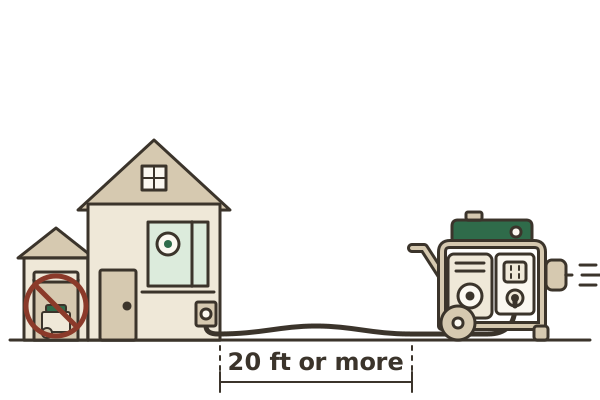
At least 20 feet, outside only, with the exhaust pointed away from your home and other buildings' entrances, says the U.S. Consumer Product Safety Commission (CPSC). Never run a portable generator inside a home, garage, basement, crawlspace or shed, or on a porch or in a carport, even with the doors and windows open.
01 Distance
Generator distance from the house: 20 feet, exhaust away
CPSC's rule is 20 feet: "Operate portable generators outside only, at least 20 feet away from the house," and "direct the generator's exhaust away from your home and other buildings' entrances." The reason is carbon monoxide, and CPSC is plain that "opening doors or windows will not provide enough ventilation to prevent the buildup of lethal levels of CO."
- Never inside: not in a home, garage, basement, crawlspace, shed or other enclosed space, and not on a porch or in a carport (CPSC).
- Windows count: the 20 feet is measured from the house, and a window is part of the house. Point the exhaust away from it.
- Not in a vehicle: Champion says never run a generator in a truck bed, SUV or trailer, or next to walls or buildings.
- Clear space around it: OSHA says give a generator 3 to 4 feet of clear space on all sides and above it; Honda says at least 3 feet from buildings and other equipment; Champion says at least 5 feet from combustible material. Those are for cooling and fire, not a replacement for the 20 foot carbon monoxide distance.
02 Carbon monoxide
Carbon monoxide is the main generator danger
Carbon monoxide from portable generators kills an average of nearly 100 people in the U.S. each year, according to CPSC's February 19, 2026 release. CPSC warns that it "can linger for hours, even after the generator has shut off."
- Where the deaths happen: ESFI, citing a 2013 CPSC study of deaths from 1999 to 2012, reports that 67 percent of generator carbon monoxide deaths happened with the generator in the living area or basement, and 26 percent in an attached garage or shed.
- Symptoms: CPSC lists them as headache, dizziness, weakness, nausea, vomiting, sleepiness, and confusion (CPSC Carbon Monoxide Information Center). If you feel any of these while a generator is running, get to fresh air and call 911.
- Cords into the house: Westinghouse warns that extension cords running directly into the home increase the risk of carbon monoxide coming in through any opening.

03 CO alarms
Put battery-backed CO alarms on every level
CPSC says to install battery-operated CO alarms, or CO alarms with battery backup, on every level of the home, and that interconnected alarms are best: when one sounds, they all sound.
- Certified: CPSC says alarms should be certified to the latest safety standards, UL 2034, IAS 6-96 or CSA 6.19.01. Westinghouse also calls for detectors that meet UL 2034.
- Tested: test the batteries monthly (CPSC).
- Even with a CO shutoff generator: WEN says the generator's own CO sensor "is not a replacement for an indoor, battery-operated CO sensor."
As an Amazon Associate, we earn from qualifying purchases.
The search below shows CO alarms from Kidde, First Alert and others. We have not verified a model, so check the listing for UL 2034 certification and battery power or battery backup.
See all carbon monoxide alarms on Amazon (opens Amazon in a new tab)04 CO shutoff
CO shutoff generators: two standards, many feature names
A CO shutoff generator turns its engine off when carbon monoxide builds up around it. CPSC says to look for one, and two voluntary standards set the rules: ANSI/PGMA G300 and UL 2201.
- Both standards require generators to shut off when certain concentrations of CO are present around them, and UL 2201 also requires a lower CO emission rate (CPSC, 2022).
- How much they help: in CPSC's simulations of 511 deaths, UL 2201 generators would avert nearly 100 percent and G300 generators nearly 87 percent. CPSC also found that market compliance with UL 2201 "appears to be minimal."
- The 2023 update: ANSI/PGMA G300-2023 lowers the CO shutoff thresholds and covers portable generators up to 15 kW; generators made after January 1, 2025 must comply, under PGMA's own membership rule as reported by OH&S in March 2024.
- Consumer Reports tests only portable generators with CO safety technology and recommends using only a generator with the feature. It also found "potentially life-threatening gaps that the automatic shutoff fails to address."
| Brand | Feature name | Where we read it |
|---|---|---|
| Honda | CO-MINDER | Honda EU2200i page |
| WEN | CO Watchdog (models ending in X) | WEN's how-to-choose guide |
| Firman | CO Alert | Firman product names |
| Generac | COsense | A Generac spec sheet link |
| Predator | CO SECURE | Consumer Reports' tested list |
We have not verified which brands certify to G300 and which to UL 2201. A CO shutoff never makes indoor use safe: run every fuel generator outside, 20 feet from the house.

05 Refueling
Refuel with the engine off and cool
Turn the generator off and let it cool before refueling: CPSC says gasoline spilled on hot engine parts could ignite.
- Wait: Champion says to let it cool for at least two minutes before removing the fuel cap. OSHA says shut it down and allow it to cool.
- Where: Honda says refuel in a well-ventilated area with the engine stopped.
- Not at the pump: Champion says do not pump gas directly into the generator at the gas station.
- Storage: never store generator fuel in the home (CPSC and OSHA).
- On propane: connect the cylinder with the hose your generator's manual names; the generic propane hoses we saw on Amazon were mostly grill and RV hoses.
06 Grounding
Grounding: often the frame, sometimes a ground rod
OSHA says a portable generator's frame can serve as its ground, with no ground rod, only when it powers cord-and-plug equipment through its own receptacles and its metal parts are bonded; otherwise a grounding electrode such as a ground rod is required.
- A generator connected to a building through a transfer switch must be connected to a grounding electrode system (OSHA).
- Honda says to consult a qualified electrician, electrical inspector or local agency on local codes before using the ground terminal.
07 Never backfeed
Never plug a generator into a wall outlet
Plugging a generator into a wall outlet to power the house wiring is backfeeding, and CPSC calls it "extremely dangerous": it presents an electrocution risk to utility workers and neighbors served by the same transformer, and it bypasses some of your home's circuit protection.
That includes a dryer outlet. A dryer receptacle is a wall outlet, so CPSC's rule covers it. To feed house circuits, have a licensed electrician install a transfer switch or an approved interlock kit.
ESFI says never to connect a generator to household wiring without first installing a transfer switch, which prevents backfeeding, and Safe Electricity says never to plug a portable generator into a wall outlet or connect it directly to a home's wiring.
08 Rain and covers
Running a generator in the rain: the sources disagree
Some say never; others say only under an open canopy on a dry surface. Follow your generator's manual, which CPSC says may advise you to wait until rain or snow passes.
Under an open canopy, on a dry surface
- CPSC: operate it "under an open, canopy-like structure on a dry surface where water cannot reach it or puddle or drain under it," and dry your hands before touching it.
- Red Cross: a dry surface under an open canopy-like structure, such as a tarp held up on poles.
- OSHA: do not use it in the rain or wet conditions; if needed, protect it with a canopy. Use GFCIs in wet or damp locations.
- Consumer Reports: large portables should not be used in rain or snow without protection, such as an open-sided tent.
Do not run it in the rain
- Generac: "Never operate your generator in the rain or on a wet surface."
- Honda: "Do not expose the generator to moisture, rain or snow."
Generac and Honda are stricter than CPSC. If your manual says not to run it in the rain, that is the rule for your generator.
Generator tents and running covers: no source we read tested them, so we do not claim any cover makes wet-weather use safe. A cover is a canopy over the machine; the 20 foot distance, the exhaust direction and the dry surface still apply.
As an Amazon Associate, we earn from qualifying purchases.
See all generator running covers on Amazon (opens Amazon in a new tab)09 Extension cords
Extension cords: outdoor rated, three prongs, the right gauge
Use heavy-duty cords made for outdoor use, with a wattage rating above the total of everything plugged into them, no cuts, and all three prongs (CPSC). OSHA adds that the cord must have a grounding conductor, and says "do not use underrated cords."
Two makers publish cord gauge charts, and they disagree. Westinghouse's is stricter: for 15 amps at 50 feet, DuroMax says 12 AWG and Westinghouse says 10. Use the stricter chart, or your own generator's manual.
DuroMax: 120 V cords
| Load | 10 ft | 25 ft | 50 ft | 100 ft | 150 ft |
|---|---|---|---|---|---|
| 5 A, 600 W | 18 AWG | 16 AWG | 14 AWG | 12 AWG | 10 AWG |
| 10 A, 1,200 W | 16 AWG | 14 AWG | 12 AWG | 12 AWG | 10 AWG |
| 15 A, 1,800 W | 14 AWG | 14 AWG | 12 AWG | 12 AWG | 10 AWG |
| 20 A, 2,400 W | 12 AWG | 12 AWG | 12 AWG | 10 AWG | 10 AWG |
Westinghouse: minimum gauge, outdoor rated (stricter)
| Total amps | Up to 50 ft | Up to 100 ft |
|---|---|---|
| Up to 10 A | 12 AWG | 8 AWG |
| Up to 15 A | 10 AWG | 8 AWG |
| Up to 20 A | 10 AWG | 6 AWG |
| Up to 30 A | 8 AWG | 6 AWG |
| Up to 35 A | 6 AWG | 6 AWG |
Amps = watts / volts (Red Cross), so a 1,200 W load at 120 V is 10 A. DuroMax also publishes a 120/240 V chart for 25 to 50 A generator cords; the interlock kit guide uses it for L14-30 and 14-50 cords.
10 Questions
Generator safety questions
How far should a generator be from the house?
At least 20 feet, outside only, with the exhaust pointed away from your home and other buildings' entrances (CPSC). Never in the house, garage, basement, crawlspace, shed, porch or carport.
How far should a generator be from a window?
CPSC measures the 20 feet from the house, and a window is part of the house, so keep the generator at least 20 feet away and point the exhaust away from it. CPSC also says opening windows will not let out enough carbon monoxide.
Can you run a generator in the rain?
The sources disagree. CPSC, the Red Cross and OSHA say that if you must, run it under an open, canopy-like structure on a dry surface where water cannot reach or puddle under it. Generac says never operate a generator in the rain or on a wet surface, and Honda says do not expose it to rain or snow. Follow your generator's manual.
Can I run a generator in the garage with the door open?
No. CPSC says never use a portable generator inside a home or garage, even if doors and windows are open. ESFI reports that 26 percent of generator carbon monoxide deaths in a 2013 CPSC study happened with the generator in an attached garage or shed.
Is a generator tent or running cover safe in the rain?
No source we read tested generator tents, so we do not claim any cover makes wet-weather use safe. CPSC's canopy advice still asks for a dry surface, the 20 foot distance and the exhaust pointed away, and some makers say not to run their generators in the rain at all.
Does a CO shutoff generator make it safe to run indoors?
No. Consumer Reports found potentially life-threatening gaps that the automatic shutoff fails to address, and WEN says its generator's CO sensor is not a replacement for an indoor, battery-operated CO alarm. A CO shutoff is a backup; run the generator outside, 20 feet from the house.
What carbon monoxide alarm should I get?
CPSC says battery-operated or battery-backup alarms, certified to UL 2034, IAS 6-96 or CSA 6.19.01, on every level of the home, interconnected if you can, with the batteries tested monthly.
Can I refuel a generator while it is running?
No. CPSC and OSHA say turn it off and let it cool before refueling, because gasoline spilled on hot engine parts could ignite. Champion says wait at least two minutes before removing the fuel cap.
What extension cord should I use with a generator?
A heavy-duty, outdoor-rated cord with three prongs and a wattage rating above the total of what is plugged into it (CPSC). For gauge, Westinghouse's chart is the stricter of the two we read: 10 AWG for up to 15 amps at 50 feet, where DuroMax says 12.
Does a portable generator need to be grounded?
Not always. OSHA says the frame can serve as the ground when the generator powers cord-and-plug equipment through its own outlets with bonded metal parts; otherwise a grounding electrode such as a ground rod is required, and a generator connected to a building through a transfer switch must be connected to a grounding electrode system. Honda says to ask a qualified electrician about local codes.
Can I plug my generator into a wall outlet?
Never, including a dryer outlet. That is backfeeding, which CPSC says can electrocute utility workers and neighbors on the same transformer. Feeding house circuits takes a transfer switch or an approved interlock installed by a licensed electrician.
Sources: CPSC release, February 19, 2026, CPSC Carbon Monoxide Information Center, CPSC safety alert, CPSC on G300 and UL 2201 (2022), OH&S on G300-2023, OSHA fact sheet, OSHA grounding, ESFI, Red Cross, Safe Electricity, Generac safety, Honda manual, Champion manual, Westinghouse manual, DuroMax cord chart, WEN, Consumer Reports (sizing guide; transfer switch article as reprinted by the Village of Vernon Hills). All read October 17, 2026.