Connect it Transfer switches
Generator transfer switch: the four ways to connect a generator to your house
There are four ways to use a generator with a house: extension cords to the appliances, an interlock kit on the main panel, a manual transfer switch, or an automatic transfer switch on a home standby generator. Only the last three feed house circuits, and each of them is a job for a licensed electrician, usually with a permit and an inspection.
Never plug a generator into a wall outlet. That is backfeeding, and CPSC says it can electrocute utility workers and neighbors.

01 At a glance
The four ways to connect a generator, side by side
Cords are the only way you can set up yourself, and they reach plug-in appliances only. The other three feed house circuits and are installed by a licensed electrician or a standby installer.
| Way | What it powers | Who installs it | Permit | Cost band (Consumer Reports) |
|---|---|---|---|---|
| Extension cords | Plug-in appliances only, each on an outdoor-rated cord | You | No house wiring is touched | Not quoted |
| Interlock kit | The breakers you switch on in your main panel | Licensed electrician | Local code decides whether an interlock is allowed; ask your electrician | $50 to $150 for the kit, plus $400 to $800 for labor |
| Manual transfer switch | The circuits wired into the switch | Licensed electrician | Most jurisdictions require a permit and an inspection (Generac) | $500 to $1,500 for the switch, including installation |
| Automatic transfer switch | The circuits on a home standby generator | Standby installer; Generac says professional installation is required | Part of the standby install | Quoted with the standby install |
Cost bands are Consumer Reports' figures for the switch and the interlock, as quoted in its transfer switch article (reprinted by the Village of Vernon Hills, read October 17, 2026). They are installation estimates, not product prices, and your electrician's quote is the real number.
02 Way one
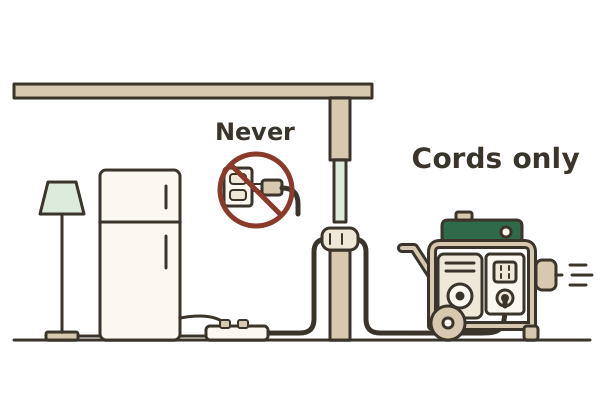
Extension cords: no house wiring, plug-in loads only
Extension cords are the simplest way: plug each appliance into an outdoor-rated, heavy-duty cord that runs to the generator, and nothing in the house is wired to it. CPSC says to use cords designed for outdoor use, make sure each cord's wattage rating exceeds the total wattage of what is plugged into it, check for cuts, and make sure the plug has all three prongs.
- What it cannot reach: hard-wired loads such as a furnace blower or a well pump. Consumer Reports notes that hard-wired items need a transfer switch.
- Carbon monoxide: Westinghouse warns that cords run directly into the home raise the risk of carbon monoxide coming in through any opening. Keep the generator at least 20 feet from the house with the exhaust pointed away (CPSC).
- Cord size: the right gauge depends on the amps and the length. Our safety guide has the two maker tables and says which is stricter.
03 Way two
Interlock kit: a bracket on your main panel
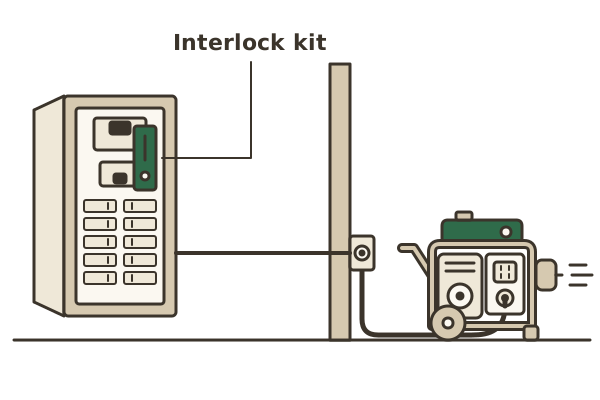
By Consumer Reports' cost bands, an interlock kit is the lowest-cost way to feed house circuits. Consumer Reports describes it as a metal bracket installed on your panel that covers the main breaker, so the main breaker and the generator breaker cannot both be on and power flows in only one direction.
- You choose the circuits with your panel's own breakers.
- Cost: $50 to $150 for the kit, plus another $400 to $800 for labor (Consumer Reports).
- Code: Consumer Reports says an electrician can tell you whether an interlock meets local building codes, and that connecting a generator without one is dangerous and, in many cases, illegal.
Kits are sold by panel brand. Our interlock kit guide covers Square D, Eaton, Siemens and GE panels and the inlet box and cord that match your generator.
04 Way three
Manual transfer switch: a small panel beside the main one
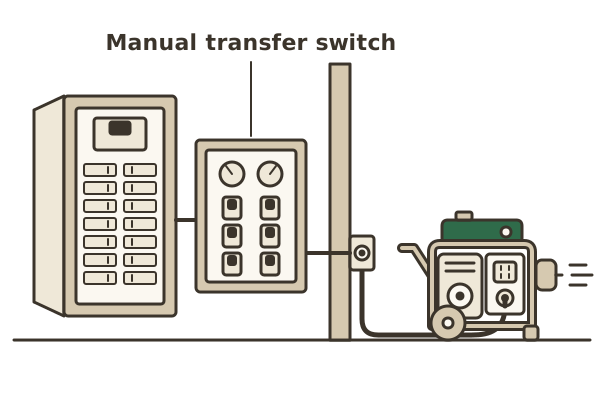
A manual transfer switch is a separate box, wired to the circuits you pick, that you flip to generator power by hand. Consumer Reports calls it "a small board that looks a bit like a circuit breaker panel itself," installed by an electrician beside the main panel, and says portable generators rated for 5,000 watts and above can connect through one.
- Cost: $500 to $1,500 for the switch, including installation, which usually takes less than a day (Consumer Reports).
- You choose the loads: the National Electrical Code ties standby sizing to a load calculation, and with manual transfer it lets the homeowner select the loads connected to the system (EC&M magazine on NEC 702.4(B)).
- OSHA's rule: never attach a portable generator to a building's wiring unless it has a properly installed open-transition transfer switch.
The Generac HomeLink 6852 below is a 30 amp manual switch; the generator cord and the power inlet box are sold separately.
05 Way four
Automatic transfer switch: part of a home standby system
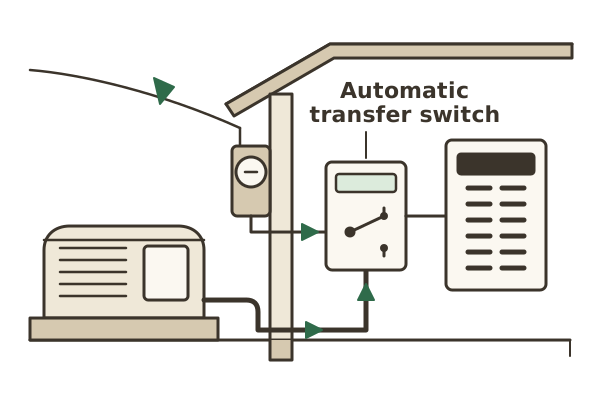
An automatic transfer switch goes with a home standby generator, the permanent kind that starts on its own in an outage.
- Installer: Generac says professional installation of a standby generator is required, not optional, and that its warranty demands it.
- Sizing: Generac asks for a professional load analysis. Our whole house sizing guide shows why everything at once usually lands in standby territory.
- Code: the code wording for automatic transfer sizing is not something we have verified, so we leave it to your installer.
Standby units are dealer or electrician installs, so we explain them and do not pick one.
06 30 amp or 50 amp
30 amp or 50 amp: match the switch to your generator's outlet
A 30 amp, 120/240 V connection carries at most 7,200 watts, and a 50 amp, 240 V connection carries at most 12,000 watts. Generac puts the 30 amp limit plainly: each outlet has its own cap, and its breaker protects that outlet, not the whole generator.
| Connection | Generator outlet | Most it carries | Verified generators with that outlet |
|---|---|---|---|
| 30 amp, 120/240 V | L14-30R (four-prong twist lock) | 7,200 W | WEN DF475T, DuroMax XP5500HX, Westinghouse WGen5300DFcv, Westinghouse WGen7500DFc, WEN DF680iX, and the three 50 amp models below |
| 50 amp, 120/240 V | 14-50R | 12,000 W | Westinghouse WGen9500DFc, DuroMax XP13000EH, Westinghouse WGen14500DFc |
The 12,000 W figure is watts = volts x amps (50 x 240), the formula Briggs and Stratton and Generac both give; Cummins states the same 12,000 W for a 50 amp RV cord. A generator with only 120 V outlets, such as a TT-30R and household outlets, has no 240 V outlet for a 240 V switch or interlock hookup.
Worked examples: which connection your list needs
Same rule as the calculator: running total, plus the single largest surge, plus 20 percent headroom, rounded up to the next 100.
| List | Running total | Largest surge | You need (running / starting) | Connection |
|---|---|---|---|---|
| Outage essentials (refrigerator, furnace blower, sump pump, 6 LED bulbs, router, 3 phone chargers, microwave) | 2,700 W | 720 W (refrigerator) | 3,300 / 4,200 W | 30 amp is enough |
| Essentials plus a 1 hp well pump | 4,200 W | 1,500 W (well pump) | 5,100 / 6,900 W | 30 amp is enough |
| Essentials, well pump and 3 ton central AC | 7,450 W | 2,250 W (central AC) | 9,000 / 11,700 W | 50 amp: the 7,450 W running total alone is over 7,200 W |
Typical figures from the Champion wattage chart; check your appliance's labels. Size your own circuits in the calculator.
07 Never backfeed
Why backfeeding a generator is dangerous
Backfeeding, plugging a generator into a wall outlet to power the house wiring, can electrocute the line workers fixing your power and your neighbors on the same transformer. CPSC calls it "extremely dangerous," and it also bypasses some of your home's built-in circuit protection.
Never plug a generator into any wall outlet, including a dryer outlet. CPSC's rule covers every wall outlet, and a dryer receptacle is one.
- Generac: backfeeding can cause shocks and damage your home's wiring, and it can send electricity back through the utility lines and injure or kill line workers.
- Honda: when utility power is restored, a backfed generator may explode, burn or cause fires.
- ESFI: never connect a generator to household wiring without first installing a transfer switch, which prevents backfeeding.
- Red Cross: backfeeding puts utility workers, your neighbors and your household at risk of electrocution.
08 Who does the work
Hire a licensed electrician for panel work
Any connection to your home's wiring, interlock or switch, is a licensed electrician's job. Honda says connections for standby power to a building must be made by a qualified electrician and must isolate generator power from utility power, and the Red Cross says the switch should be installed to the National Electrical Code and state and local codes.
- Permit and inspection: Generac says most jurisdictions require you to pull an electrical permit and pass an inspection for a transfer switch.
- Grounding: OSHA says a generator connected to a building through a transfer switch must be connected to a grounding electrode system. Your electrician handles it.
- Do it yourself? Generac writes that you can install a transfer switch yourself if you are comfortable with electricity, but that it carries serious safety risks. OSHA, Honda, the Red Cross and WEN all say to use a qualified or professional electrician, and so do we.
Then keep the generator itself outside, at least 20 feet from the house, with the exhaust pointed away. The generator safety guide covers carbon monoxide, rain, refueling and cords.
09 The parts
A transfer switch, cords and inlets
We verified one manual transfer switch against its maker page and its Amazon listing: the 30 amp Generac HomeLink 6852. The search links show the rest of each class; check the amps and plug types before you buy.
As an Amazon Associate, we earn from qualifying purchases.
Generac HomeLink 30A Transfer Switch (6852)
A 30 amp manual transfer switch for a portable generator with an L14-30R outlet. The listing says 8 circuits come pre-wired, expandable to 10.
- What it is
- 30 A manual transfer switch for a portable generator; powers selected hard-wired circuits
- Fits
- Generators with a 30 A L14-30R outlet
- Sold separately
- The generator cord and the power inlet box (maker page)
- Listing
- Same model as the maker page; ships from and sold by Amazon.com when we checked
Not a fit for: 50 A hookups; wiring by anyone who is not a licensed electrician. Hire one, and check your local permit rules.
Find it on Amazon (opens Amazon in a new tab)Other manual transfer switches
The search shows 30 amp manual switches from several makers, plus some automatic DIN-rail switches that are not the same thing. We have not verified those models.
Look for: a manual switch, the amps that match your generator's outlet, and the number of circuits you need.
See all manual transfer switches on Amazon (opens Amazon in a new tab)
Cords and inlet boxes by connection
30 amp (L14-30)
An L14-30 cord runs from the generator's L14-30R to a 30 amp inlet on the house. DuroMax's cord chart puts a 30 A cord up to 50 ft at 10 AWG; Westinghouse's stricter chart says 8 AWG up to 50 ft.
See all 30 amp generator cords on Amazon (opens Amazon in a new tab) See all 30 amp inlet boxes on Amazon (opens Amazon in a new tab)50 amp (14-50)
A 50 amp cord has a 14-50P plug for the generator's 14-50R; the house end must match your inlet. The 50 amp cords in the search are lesser-known brands, so check both ends.
See all 50 amp generator cords on Amazon (opens Amazon in a new tab) See all 50 amp inlet boxes on Amazon (opens Amazon in a new tab)Your electrician picks and installs the inlet and the breaker; buy the cord to match what they put in.
10 Questions
Transfer switch questions
Do I need a transfer switch for a portable generator?
Only if you want it to power house circuits. Plug-in appliances can run on outdoor-rated extension cords with no switch. To feed hard-wired loads such as a furnace blower or a well pump, you need a transfer switch or an approved interlock kit, installed by a licensed electrician. OSHA says never attach a portable generator to a building's wiring without a properly installed transfer switch.
What is the difference between a manual and an automatic transfer switch?
You flip a manual transfer switch by hand after you start a portable generator, and it feeds only the circuits wired into it. An automatic transfer switch goes with a home standby generator, which starts on its own in an outage. Generac says a standby install must be done by a professional.
How do I connect a generator to my house?
Safely, one of four ways: extension cords to the appliances, an interlock kit on your main panel, a manual transfer switch, or an automatic switch on a standby unit. The last three are installed by a licensed electrician, who connects an inlet on the outside wall that your generator plugs into with a cord. Never plug the generator into a wall outlet.
How much does a generator transfer switch cost?
Consumer Reports puts a transfer switch at $500 to $1,500 including installation, which usually takes less than a day, and an interlock kit at $50 to $150 plus $400 to $800 for labor. Those are its installation estimates; your electrician's quote is the real number.
Can I install a generator transfer switch myself?
We say no: hire a licensed electrician. Generac notes that you can if you are comfortable working with electricity, but that it carries serious safety risks and that most jurisdictions require a permit and an inspection. Honda, OSHA and the Red Cross all say the connection must be made by a qualified electrician.
What size transfer switch do I need?
Match it to your generator's 240 V outlet: a 30 amp switch for an L14-30R, which carries up to 7,200 W (Generac), or a 50 amp setup for a 14-50R, which carries up to 12,000 W. Then size the circuits you will run: our outage essentials list needs 3,300 running and 4,200 starting watts, well inside a 30 amp connection.
What size generator can connect through a transfer switch?
Consumer Reports says portable generators rated for 5,000 watts and above can connect through one. The generator also needs a 240 V locking outlet, an L14-30R or a 14-50R, to feed a 240 V switch. Size it to the circuits you will run at once with the calculator.
What is backfeeding a generator?
Backfeeding is powering your house wiring by plugging a generator into a wall outlet. CPSC calls it extremely dangerous: it presents an electrocution risk to utility workers and neighbors served by the same transformer, and it bypasses some of your home's circuit protection.
Can I plug a generator into my dryer outlet?
No. A dryer receptacle is a wall outlet, and CPSC says never to power house wiring by plugging a generator into a wall outlet. Feeding the house takes a transfer switch or an approved interlock, installed by a licensed electrician.
Does Generac make a transfer switch for portable generators?
Yes. The Generac HomeLink 6852 is a 30 amp manual transfer switch for a portable generator with an L14-30R outlet; its listing says 8 circuits come pre-wired, expandable to 10. Generac sells the cord and the power inlet box separately. Generac's home standby generators come with their own transfer switch (for example, the Guardian 14 kW with a 16-circuit switch) and are installed by a professional.
Sources: Consumer Reports, Why a Portable Generator Needs a Transfer Switch, as reprinted by the Village of Vernon Hills; CPSC portable generator safety alert; OSHA; Generac on outlet limits; Generac sizing guide; Honda manual; ESFI; Red Cross; EC&M on the NEC; DuroMax cord chart; Generac HomeLink 6852. All read October 17, 2026.