Connect it Interlock kits
Generator interlock kit: how it works and which one fits your panel
A generator interlock kit is a metal bracket on your main breaker panel that keeps the main breaker and the generator breaker from being on at the same time, so power flows in only one direction (Consumer Reports). The kit has to match your panel's brand and model, your generator plugs into it through an inlet box and a cord, and a licensed electrician installs it.

01 How it works
How a generator interlock works
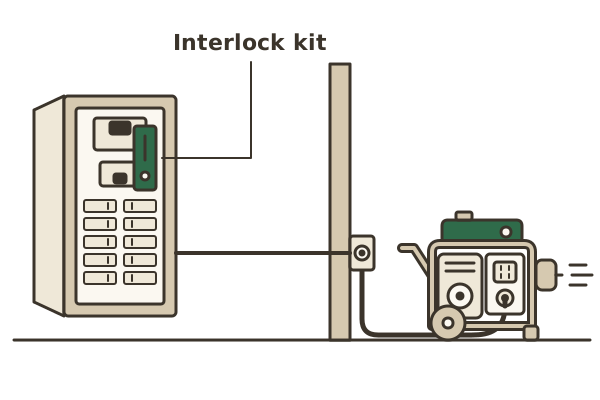
An interlock works by blocking: the plate physically stops the main breaker and the generator breaker from being on together, so power flows in only one direction and cannot backfeed the utility lines. Consumer Reports describes it as "a metal bracket installed on your panel" that covers the main breaker.
- Utility power on: the main breaker is on and the plate holds the generator breaker off.
- Outage: with the main breaker off, the plate slides and the generator breaker can go on.
- The generator sits outside, at least 20 feet from the house, and plugs into an inlet box on the wall through a generator cord.
- You choose what runs with your panel's own breakers, keeping the total inside what your generator and your connection carry.
Connecting a generator to a panel without an interlock or a transfer switch is "dangerous, and in many cases, illegal," Consumer Reports says. That includes plugging it into any wall outlet, which is backfeeding.
02 By panel brand
Which interlock kit fits your panel
The kit that fits is the one made for your panel's brand and model. Interlock kits are sold panel by panel, so read the model on your panel's label first and match it to the listing.
As an Amazon Associate, we earn from qualifying purchases.
| Panel brand | Check before you buy | Search |
|---|---|---|
| Square D | The listing names your Square D panel's model, not just the brand | Square D kits on Amazon (opens Amazon in a new tab) |
| Eaton | The listing names your Eaton panel's model | Eaton kits on Amazon (opens Amazon in a new tab) |
| Cutler-Hammer | The listing names your Cutler-Hammer panel's model | Cutler-Hammer kits on Amazon (opens Amazon in a new tab) |
| Siemens | The listing names your Siemens panel's model | Siemens kits on Amazon (opens Amazon in a new tab) |
| GE | The listing names your GE panel's model | GE kits on Amazon (opens Amazon in a new tab) |
| Other brands | Search with your panel's brand and model in the box | All interlock kits on Amazon (opens Amazon in a new tab) |
Before you buy any kit
- Match the panel model. When we checked the interlock kit search, every result was a kit from a lesser-known maker sold by panel brand. We have not verified any of them against a maker spec sheet, so we name no model.
- Ask your electrician first. Consumer Reports says an electrician can tell you whether an interlock meets local building codes.
- Plan the permit. Generac says most jurisdictions require an electrical permit and an inspection for this kind of work.
- Match the inlet and cord to your generator, below.
03 Inlet box and cord
The inlet box and cord that match your generator's outlet
Match both to the 240 V locking outlet on your generator: an L14-30R takes a 30 amp cord and inlet and carries up to 7,200 watts (Generac), and a 14-50R takes a 50 amp cord and inlet and carries up to 12,000 watts.
| Generator outlet | Carries up to | Cord | Inlet box | Verified generators with it |
|---|---|---|---|---|
| L14-30R, 30 A, 120/240 V | 7,200 W | L14-30P to L14-30R; DuroMax's chart says 10 AWG up to 50 ft, Westinghouse's stricter one says 8 AWG | 30 amp | WEN DF475T, DuroMax XP5500HX, Westinghouse WGen5300DFcv, Westinghouse WGen7500DFc, WEN DF680iX, and the three below |
| 14-50R, 50 A, 120/240 V | 12,000 W | 14-50P at the generator end; the house end must match the inlet. DuroMax's chart says 6 AWG up to 50 ft | 50 amp | Westinghouse WGen9500DFc, DuroMax XP13000EH, Westinghouse WGen14500DFc |
| TT-30R or household outlets only, 120 V | Not for this | None | None | No 240 V outlet, so no 240 V panel hookup, for example the WGen3600DFc |
12,000 W is watts = volts x amps (50 x 240), the formula Briggs and Stratton and Generac both give. Your electrician picks and installs the inlet and the generator breaker; buy the cord to match what they put in.
Champion 25 ft 30A Generator Cord (100395)
25 ft of 10 AWG cord, L14-30 plug to L14-30 connector: the cord a 30 amp inlet takes.
- What it is
- 25 ft, 10 AWG, 30 A, 125/250 V, L14-30 plug to L14-30 connector
- Fits
- Generators with an L14-30R outlet feeding a 30 A inlet or switch
- Listing
- Brand and specs match; confirm the model number on the listing
Not a fit for: generators with only a 14-50R or TT-30R; 50 A hookups.
Find it on Amazon (opens Amazon in a new tab)Inlet boxes and 50 amp cords
We have not verified a model of either. The 50 amp cords we saw were lesser-known brands, so check both plug ends and the amp rating on the listing.
See all 30 amp inlet boxes on Amazon (opens Amazon in a new tab) See all 50 amp inlet boxes on Amazon (opens Amazon in a new tab) See all 30 amp generator cords on Amazon (opens Amazon in a new tab) See all 50 amp generator cords on Amazon (opens Amazon in a new tab)
04 What it can run
What an interlock can run: whatever your generator and cord carry
An interlock lets you turn on any breaker in the panel, so the limit is your generator's rating and your connection: 7,200 watts through a 30 amp cord, 12,000 through a 50 amp one. Size the circuits you will run at once with the same rule as the calculator.
| List | Running total | Largest surge | You need (running / starting) | Hookup |
|---|---|---|---|---|
| Outage essentials (refrigerator, furnace blower, sump pump, 6 LED bulbs, router, 3 phone chargers, microwave) | 2,700 W | 720 W (refrigerator) | 3,300 / 4,200 W | 30 amp, with a generator that has an L14-30R |
| Essentials plus a 1 hp well pump | 4,200 W | 1,500 W (well pump) | 5,100 / 6,900 W | 30 amp, for example the WGen7500DFc (7,500 / 9,500 W) |
| Essentials, well pump and 3 ton central AC | 7,450 W | 2,250 W (central AC) | 9,000 / 11,700 W | 50 amp, for example the WGen9500DFc (9,500 / 12,500 W) |
Running total, plus the single largest surge, plus 20 percent headroom, rounded up to the next 100. The essentials list: 2,700 + 720 = 3,420 W starting; times 1.2 is 3,240 running and 4,104 starting, so 3,300 and 4,200. Typical figures from the Champion wattage chart; check your appliance's labels. Size your own list in the calculator, and see whole house sizing for when a portable stops being enough.
05 Permit and electrician
Have a licensed electrician install it, with a permit
An interlock is panel work, so it is a licensed electrician's job. Honda says connections for standby power to a building must be made by a qualified electrician and must isolate generator power from utility power.
- Code: whether an interlock is allowed is a local call. Consumer Reports says an electrician can tell you whether an interlock meets local building codes, and OSHA's own rule names a properly installed open-transition transfer switch.
- Permit: Generac says most jurisdictions require you to pull an electrical permit and pass an inspection.
- Grounding: OSHA requires a grounding electrode system for a generator connected to a building through a transfer switch. Your electrician handles grounding for your hookup.
Never plug a generator into a wall outlet, including a dryer outlet. That is backfeeding; CPSC says it can electrocute utility workers and neighbors served by the same transformer. Run the generator outside, at least 20 feet from the house, exhaust pointed away. Generator safety.
06 Interlock or transfer switch
Interlock kit vs transfer switch
Both do the same safety job, keeping generator and utility power apart, and both are installed by an electrician. The interlock costs less by Consumer Reports' figures and uses your existing panel; the transfer switch is a separate box with its own circuits.
Interlock kit
- A metal bracket on the main panel that covers the main breaker (Consumer Reports).
- Any breaker in the panel can run on the generator; you pick them.
- Cost: $50 to $150 for the kit, plus $400 to $800 for labor (Consumer Reports).
- Code acceptance varies; your electrician knows your local rules.
Manual transfer switch
- "A small board that looks a bit like a circuit breaker panel," installed beside the main panel (Consumer Reports).
- Feeds only the circuits wired into it, for example 8 pre-wired on the Generac HomeLink 6852, expandable to 10.
- Cost: $500 to $1,500 including installation, which usually takes less than a day (Consumer Reports).
- OSHA names a properly installed transfer switch in its rule.
Cost bands are Consumer Reports' installation estimates, as quoted in its transfer switch article (reprinted by the Village of Vernon Hills, read October 17, 2026), not product prices. More on the four ways to connect in our transfer switch guide.
07 Questions
Interlock kit questions
What is a generator interlock kit?
It is a metal bracket installed on your main breaker panel that covers the main breaker, so the main breaker and the generator breaker cannot both be on and power flows in only one direction (Consumer Reports). It lets a portable generator feed the circuits you choose without backfeeding the utility lines.
Is a generator interlock kit legal?
It depends on your local code. Consumer Reports says an electrician can tell you whether an interlock meets local building codes, and that connecting a generator to a panel without one is dangerous and, in many cases, illegal. Generac says most jurisdictions require a permit and an inspection for this work.
Interlock vs transfer switch: which should I get?
Both keep generator and utility power apart. An interlock costs less ($50 to $150 for the kit plus $400 to $800 for labor, per Consumer Reports) and lets you run any breaker in your panel. A manual transfer switch ($500 to $1,500 installed, per Consumer Reports) feeds only the circuits wired into it. Where local code allows both, the interlock is usually the cheaper route; your electrician knows the local rules.
Which interlock kit fits my panel?
The one made for your panel's brand and model. Kits are sold by panel brand, such as Square D, Eaton, Cutler-Hammer, Siemens and GE. Read the model on your panel's label and check that the listing names it, then have your electrician confirm the fit.
What cord do I need for a generator interlock?
One that matches your generator's 240 V outlet and your inlet. A generator with an L14-30R takes an L14-30 cord such as the Champion 100395 (25 ft, 10 AWG). A generator with a 14-50R takes a 50 amp cord with a 14-50P plug. DuroMax's cord chart calls for 10 AWG on a 30 amp cord up to 50 ft; Westinghouse's stricter chart says 8 AWG.
What is a generator inlet box?
It is the socket on the outside of the house that your generator cord plugs into; your electrician wires it to the generator breaker in the panel. Match it to the cord: 30 amp for an L14-30 cord, 50 amp for a 50 amp cord.
Can I install an interlock kit myself?
We say hire a licensed electrician. Honda says connections to a building's electrical system must be made by a qualified electrician, OSHA and the Red Cross say the same, and most jurisdictions require a permit and an inspection (Generac).
What size generator do I need for an interlock kit?
One with a 240 V locking outlet (L14-30R or 14-50R) and enough watts for the circuits you will run at once. Our outage essentials list needs 3,300 running and 4,200 starting watts; adding a 1 hp well pump takes it to 5,100 and 6,900; adding a 3 ton central AC takes it to 9,000 and 11,700, which needs a 50 amp hookup.
Sources: Consumer Reports, Why a Portable Generator Needs a Transfer Switch, as reprinted by the Village of Vernon Hills; Generac on outlet limits; Generac sizing guide; OSHA grounding fact sheet; Honda manual; CPSC; DuroMax cord chart; Westinghouse manual; Champion 100395. All read October 17, 2026.