By situation Whole house
What size generator do I need to run a house?
Briggs and Stratton says the essential items in a typical home average 5,000 to 7,000 running watts, and Champion says most 2,000 sq ft homes need a 5,000 to 7,500 watt generator for the essentials. Running everything at once, central air included, takes 10,000 watts or more (Champion) and usually means a home standby generator sized by an electrician's load calculation.
Our lean outage list needs less, 4,200 starting watts, because it leaves out the well pump, laundry and air conditioning.
01 Size yours
How much of the house do you want on?
Your generator size
Sized for Essentials in an outage (14 items)
Your generator needs at least
4,200 starting watts
and about 3,300 running watts
Portable fits
A mid-size inverter or small portable generator covers this.
Class: Mid-size inverter (3,000 to 4,500 W) or small portable (2,000 to 4,000 W)
As an Amazon Associate, we earn from qualifying purchases.
Verified picks for this size
WEN DF475T
Covers your 3,300 running and 4,200 starting watts
Has the 240 V L14-30R outlet that a 30 A transfer switch or interlock hookup needs.
3,800 W running · 4,750 W peak · gas or propane · 120/240 V
Find it on Amazon (opens Amazon in a new tab)Westinghouse WGen3600DFc
Covers your 3,300 running and 4,200 starting watts
A 120 V dual fuel portable with an RV-ready TT-30R outlet and a CO sensor shutoff.
3,600 W running · 4,650 W peak · gas or propane · 120 V only
Find it on Amazon (opens Amazon in a new tab)Westinghouse iGen5000DFc
Covers your 3,300 running and 4,200 starting watts
A dual fuel inverter with an RV TT-30R outlet, 3,900 running watts and a CO sensor.
3,900 W running · 5,000 W peak · gas or propane · 120 V only
Find it on Amazon (opens Amazon in a new tab)
All our verified picks for this size, with specs
On any listing, check two numbers: at least 3,300 running watts and 4,200 starting (peak) watts. Listings often lead with the peak figure.
Check your plugs. Honda’s wattage guide lists furnace fans and sump pumps as 240 V loads. A 240 V load needs a generator with a 120/240 V outlet, and a hard-wired load needs a transfer switch. Each pick lists its outlets.
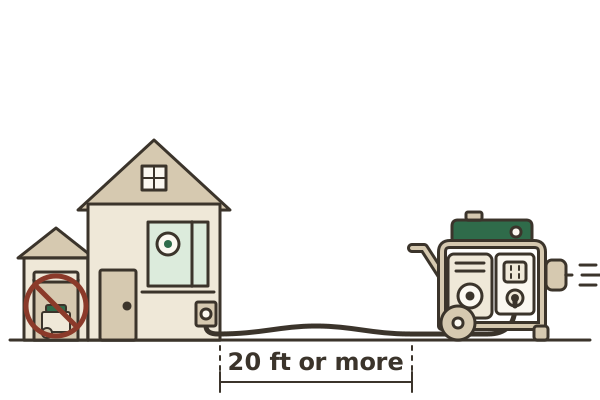
How to connect it to the house. Run it outside only, at least 20 feet from the house, exhaust pointed away (CPSC).
Show the math
- Running total: 2,700 W
- Largest single starting surge: 720 W (Refrigerator)
- Starting total: 2,700 + 720 = 3,420 W
- Plus 20 percent headroom: 3,240 W running, 4,104 W starting
- Rounded up to the next 100: 3,300 W running, 4,200 W starting
Typical figures; check your appliance's labels. Every list can be edited in the full calculator.
Each list is filled from the same wattage chart as the calculator, and the picks update with it.
Change the items in the full calculator
Connecting to the house: a transfer switch or an approved interlock, installed by a licensed electrician, is the only safe way to feed house circuits. How transfer switches work.
02 Worked example
Three ways to power a house, worked out
The essentials need 3,300 running and 4,200 starting watts, a portable generator's job. A whole house with gas heat needs 14,900 running and 20,300 starting watts, and an all-electric house 40,500 and 43,200, both standby territory. Each uses the calculator's rule: running total, plus the single largest surge, plus 20 percent headroom, rounded up to the next 100.
| Situation | Running total | Largest surge | Starting total | You need (running / starting) | Where it lands |
|---|---|---|---|---|---|
| Essentials in an outage | 2,700 W | 720 W (refrigerator) | 3,420 W | 3,300 / 4,200 W | Portable fits |
| Whole house, gas heat | 12,340 W | 4,500 W (gas dryer) | 16,840 W | 14,900 / 20,300 W | Standby territory |
| Whole house, all electric | 33,740 W | 2,250 W (central AC 3 ton) | 35,990 W | 40,500 / 43,200 W | Standby territory |
What is on the whole house, gas heat list
| Item and source | How many | Running W | Starting W (one) |
|---|---|---|---|
| Refrigerator Champion wattage chart | 1 | 280 | 1,000 |
| Furnace blower 1/2 hp Champion wattage chart | 1 | 550 | 1,200 |
| Sump pump 1/3 hp Champion wattage chart | 1 | 650 | 1,300 |
| LED bulb Champion wattage chart | 6 | 120 | 20 |
| Internet router/modem Champion wattage chart | 1 | 20 | 20 |
| Phone charger Champion wattage chart | 3 | 180 | 60 |
| Microwave Champion wattage chart | 1 | 900 | 900 |
| Well pump 1 hp Champion wattage chart | 1 | 1,500 | 3,000 |
| Electric range (one burner) Champion wattage chart | 1 | 1,800 | 1,800 |
| Washing machine Champion wattage chart | 1 | 750 | 1,650 |
| Gas dryer Briggs and Stratton worksheet | 1 | 1,800 | 6,300 |
| Central AC 3 ton Champion wattage chart | 1 | 3,250 | 5,500 |
| TV Champion wattage chart | 1 | 240 | 240 |
| Desktop computer Briggs and Stratton worksheet | 1 | 300 | 300 |
| Running total | 21 | 12,340 | + 4,500 (gas dryer) |
12,340 W running plus the gas dryer's 4,500 W surge is 16,840 W. With 20 percent headroom: 14,900 running and 20,300 starting watts. That is past the portable ceiling, so this list is a job for a home standby unit and an electrician's load calculation, or for a shorter list on a large portable.
Every figure in these lists is a typical one from the appliance wattage chart, which shows each source and its range.
03 The two classes houses land in
Generators for a house
Champion's 5,000 to 7,500 W essentials range, plus 20 percent headroom, points to a 7,000 to 10,000 W portable. Adding central air (10,000 W or more) points to the 10,000 W and up class.
As an Amazon Associate, we earn from qualifying purchases.
Large portable: 7,000 to 10,000 W
Westinghouse WGen7500DFc
7,500 running watts and an L14-30R outlet for essential circuits through a transfer switch.
- Running / peak
- 7,500 / 9,500 W on gas
- On propane
- 6,750 / 8,550 W
- Fuel
- Gasoline or propane
- Outlets
- two 120V duplex 5-20R, 120/240V L14-30R, 2 USB
- CO shutoff
- Yes
- Weight
- 202.1 lb
- Noise
- 72 dBA, maker figure
- Listing
- Brand and specs match; confirm the model number on the listing
Not a fit for: RV hookup (the maker lists RV Ready: No, and there is no TT-30R); a 50 A inlet.
Find it on Amazon (opens Amazon in a new tab)Westinghouse WGen9500DFc
Adds a 50 A 14-50R outlet, so it fits a 50 A inlet or a 50 A RV plug.
- Running / peak
- 9,500 / 12,500 W on gas
- On propane
- 8,500 / 11,200 W
- Fuel
- Gasoline or propane
- Outlets
- two 120V GFCI 5-20R, 120/240V L14-30R, 120/240V 14-50R (50A)
- CO shutoff
- Yes
- Weight
- 221 lb
- Noise
- 74 dBA, maker figure
- Listing
- Brand and specs match; confirm the model number on the listing
Not a fit for: whole-house backup when the running load is above 9,500 W; a TT-30 RV plug without an adapter.
Find it on Amazon (opens Amazon in a new tab)
Extra-large portable: 10,000 W and up
DuroMax XP13000EH
10,500 running watts with both 30 A and 50 A outlets for a larger home hookup.
- Running / peak
- 10,500 / 13,000 W on gas
- On propane
- 10,000 / 12,500 W
- Fuel
- Gasoline or propane
- Outlets
- 120V 20A GFCI 5-20, 120V L5-30, 120/240V L14-30, 120/240V 14-50 (50A), 12V DC
- CO shutoff
- Yes, per the maker's spec table
- Weight
- 234 lb
- Noise
- 74 dB, maker figure
- Listing
- Same model as the maker page
Not a fit for: carrying by hand (234 lb dry); quiet campgrounds.
Find it on Amazon (opens Amazon in a new tab)Westinghouse WGen14500DFc
The highest running watts of the portables we checked: 14,500 W on gas, with a 50 A outlet.
- Running / peak
- 14,500 / 18,000 W on gas
- On propane
- 13,000 / 16,000 W
- Fuel
- Gasoline or propane
- Outlets
- two 120V GFCI 5-20R, 120V 30A L5-30, 120/240V 30A L14-30R, 120/240V 50A 14-50R, 2 USB
- CO shutoff
- Yes
- Weight
- 352 lb (from the sister model page and the listing)
- Noise
- as low as 74 dBA, maker figure
- Listing
- Same model as the maker page
Not a fit for: moving by hand; anyone who needs automatic start in an outage (that is a standby unit).
Find it on Amazon (opens Amazon in a new tab)
On propane these dual fuel models make less (Champion: about 10 percent less than gasoline); each card lists both figures. More sizes in the portable generator buying guide.
04 Portable or standby
A portable with a switch, or a home standby?
Portable plus a transfer switch or interlock
- You choose the circuits it feeds. With manual transfer, the National Electrical Code lets the homeowner select the loads.
- Consumer Reports says portables rated 5,000 W and above can connect through a transfer switch.
- You start it, fuel it and run it outside, at least 20 feet from the house (CPSC).
- Covers the essentials range: the 7,000 to 10,000 W and 10,000 W and up classes above.
Home standby
- A permanent install fed by natural gas or propane and wired through a transfer switch. Generac says professional installation is required.
- Sized from a load analysis. Generac's examples: 10 to 14 kW for a 1,550 sq ft home with load managers, 18 to 22 kW for 2,000 sq ft.
- Natural gas lowers output: Generac's 22 kW unit is rated 22,000 W on propane and 19,500 W on natural gas.
- We link the class searches only and never pick a standby model; an installer quotes the job.
As an Amazon Associate, we earn from qualifying purchases.
See 16 to 22 kW home standby generators on Amazon (opens Amazon in a new tab)Never plug a generator into a wall outlet, including a dryer outlet. That is backfeeding, and CPSC says it puts utility workers and neighbors at risk of electrocution. Connecting to house wiring takes a transfer switch or an approved interlock installed by a licensed electrician; most jurisdictions require a permit and an inspection (Generac).
Run it outside only, at least 20 feet from the house with the exhaust pointed away from doors and windows, never in a garage even with the door open, and put battery-backed CO alarms on every level (CPSC). Generator safety.
05 Questions
Whole house generator questions
What size generator do I need for a 2,000 sq ft house?
For the essentials, Champion says most 2,000 sq ft homes need a 5,000 to 7,500 watt generator, and 10,000 watts or more to run central air. For a home standby unit, Generac sizes a 2,000 sq ft home at 18 to 22 kW. Generac's own page also calls 22 kW the standard for 2,500 to 3,000 sq ft, so treat square footage as a starting point and size from your loads.
What size standby generator runs a 1,550 sq ft home?
Generac's example puts a 1,550 sq ft home at 10 to 14 kW with load managers, and 18 kW with a heat pump or high-draw medical equipment. Generac also asks for a professional load analysis before you buy.
Will a portable generator run my whole house?
Usually not everything at once. Our whole house list with gas heat needs 14,900 running and 20,300 starting watts, which is standby territory, and the all electric list needs 40,500 running watts. A portable on a transfer switch or interlock runs the circuits you choose: with manual transfer, the National Electrical Code lets the homeowner select the loads.
Do I need a transfer switch to connect a generator to my house?
Yes. Honda says the connection to a building's wiring must be made by a qualified electrician and must isolate generator power from utility power, and OSHA says to use a transfer switch installed by a qualified electrician. Consumer Reports adds that an interlock kit does the same job where local code allows it. Generac notes that most jurisdictions require a permit and an inspection.
Transfer switch or interlock kit?
Consumer Reports describes a transfer switch as a small board, like a mini breaker panel, that an electrician installs beside the main panel, and an interlock kit as a metal bracket on the panel that keeps the main breaker and the generator breaker from being on at the same time. An electrician can tell you whether an interlock meets your local code.
Can I run the generator in the garage with the door open?
No. CPSC says never run a portable generator inside a home, garage, basement, crawlspace or shed, and that opening doors or windows will not let out enough carbon monoxide. Run it outside, at least 20 feet from the house, exhaust pointed away.
Does natural gas lower a standby generator's output?
Yes. Champion says natural gas typically delivers 10 to 15 percent less than gasoline. Generac's 22 kW standby spec sheet lists 22,000 W on propane and 19,500 W on natural gas, so size against the natural gas figure if that is your fuel.
What is load management?
Generac describes its Load Manager as temporarily pausing a lower-priority load to keep power stable, and says its Smart Management Modules can, in many cases, reduce the overall size and cost of the generator you need.
Sources: Champion, Briggs and Stratton worksheet, Generac, Generac 20/22/24 kW spec sheet, Consumer Reports (transfer switch article, as reprinted by the Village of Vernon Hills), Honda manual, OSHA, CPSC, EC&M on the NEC. All read October 17, 2026.


