Learn Running vs starting watts
Running watts vs starting watts
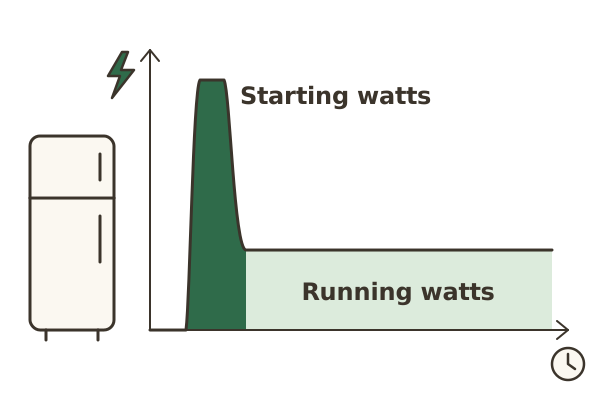
Running watts are what an appliance draws while it runs. Starting watts are the short extra burst a motor needs to get going, for two to three seconds by Briggs and Stratton's account. A generator has the same pair: rated watts it can hold all day and peak watts it can give for a moment.
Size for both: your running total must fit the generator's rated watts and your starting total must fit its peak watts.
01 The difference
Why motors need more watts to start
A motor or compressor needs extra power to get moving from a standstill, and much less to keep moving.
Cummins compares it to starting a bicycle uphill from a dead stop: hard work at first, then easy once the bike has momentum. The loads that behave this way are motors and compressors, and Cummins names air conditioners, sump pumps, refrigerators and power tools. Briggs and Stratton puts it plainly: only motor-driven items require additional starting watts.
- Running (rated) watts: the continuous watts needed to keep an item running (Briggs and Stratton). Generac calls it the steady-state power the appliance draws during normal operation.
- Starting (surge) watts: the extra watts needed for two to three seconds to start a motor-driven product like a refrigerator or a circular saw (Briggs and Stratton). Champion says they are typically 1 to 2 times the running wattage and last only a fraction of a second; Generac says often two to three times.
- No surge: heating loads such as toasters, coffee makers, space heaters and bulbs draw the same watts from the first second.
02 The math
How to add running and starting watts
Add the running watts of everything that runs at once, then add only the largest starting surge of any one item. Every generator maker we read uses this method.
- Add the running watts of everything you want on at the same time.
- Find the one item with the biggest surge: the largest gap between its starting and running watts. Briggs and Stratton: in most cases only one item will start or cycle at the same time.
- Add that one surge to your running total. Briggs and Stratton: you need a generator that produces at least this many starting watts.
- Add 20 percent headroom to both numbers. A Cummins dealer article advises 20 to 25 percent; we use 20.
Worked example: outage essentials
| Item and source | How many | Running W | Starting W (one) |
|---|---|---|---|
| Refrigerator Champion wattage chart | 1 | 280 | 1,000 |
| Furnace blower 1/2 hp Champion wattage chart | 1 | 550 | 1,200 |
| Sump pump 1/3 hp Champion wattage chart | 1 | 650 | 1,300 |
| LED bulb Champion wattage chart | 6 | 120 | 20 |
| Internet router/modem Champion wattage chart | 1 | 20 | 20 |
| Phone charger Champion wattage chart | 3 | 180 | 60 |
| Microwave Champion wattage chart | 1 | 900 | 900 |
| Running total | 14 | 2,700 | + 720 (refrigerator) |
- Running total: 2,700 W
- Largest single starting surge: 720 W (Refrigerator)
- Starting total: 2,700 + 720 = 3,420 W
- Plus 20 percent headroom: 3,240 W running, 4,104 W starting
- Rounded up to the next 100: 3,300 W running, 4,200 W starting
So this list needs a generator rated for at least 3,300 running watts with at least 4,200 starting (peak) watts. Adding every item's starting watts instead would count surges that never happen together. Open this list in the calculator and change it to match your house.
The makers' own examples
- Westinghouse: 2,590 running watts plus the highest additional surge of 1,600 gives 4,190 total starting watts.
- Champion: 3,880 running watts plus the refrigerator's 2,200 starting watts gives 6,080. Champion adds the item's full starting figure rather than only the extra, which counts that item's running watts twice and gives a slightly bigger number.
- Cummins: add the starting watts for your single largest motor load to the running watts of every other load, and do not simply add up running watts. Cummins says any website that does that is not a good approach.
- DTE Energy is the stricter dissent: its worksheet multiplies each appliance by a starting factor and adds them all, which gives a much bigger number than the makers' one-largest-surge method.
03 Read the label
Check whether a chart lists total or extra starting watts
Some charts list the total starting watts and some list only the extra on top of running, so read the column heading before you add.
Champion, Honda, Westinghouse and Cummins list the total. Briggs and Stratton and Firman list the additional watts, the surge on top of running. DTE Energy gives a starting factor to multiply by the running watts. The refrigerator shows the gap:
- Briggs and Stratton: 550 running watts, plus 1,350 additional to start, so 1,900 total.
- Westinghouse: 700 running watts, 2,200 starting watts total.
- Champion: 150 to 400 running watts, 800 to 1,200 starting watts total. Our typical refrigerator, 280 running and 1,000 starting, is the middle of Champion's ranges.
Treat an "additional" figure as a total and you undercount the surge; add a "total" figure on top of running and you count the item twice. Our wattage chart turns every source into a total and marks the converted ones "computed".
04 High-surge loads
The loads with the biggest starting surge
Compressors and pumps surge the most: heat pumps, air conditioners, well pumps, air compressors, and a gas dryer's drum motor.
| Load and source | Running W | Starting W | Surge W | Starting W in our sources |
|---|---|---|---|---|
| Air compressor 2 hp Champion wattage chart | 2,500 | 7,500 | 5,000 | 7,500 W (1 source) |
| Heat pump Briggs and Stratton worksheet | 4,700 | 9,200 | 4,500 | 9,200 to 18,000 W (2 sources) |
| Gas dryer Briggs and Stratton worksheet | 1,800 | 6,300 | 4,500 | 6,300 W (1 source) |
| Air compressor 1 hp Champion wattage chart | 1,500 | 4,500 | 3,000 | 4,500 to 5,000 W (4 sources) |
| Well pump 3/4 hp DTE Energy worksheet | 1,500 | 4,500 | 3,000 | 4,500 W (1 source) |
| Central AC 4 ton Champion wattage chart | 4,500 | 7,250 | 2,750 | 6,500 to 8,000 W (1 source) |
| Table saw 10 in Champion wattage chart | 2,400 | 4,800 | 2,400 | 2,000 to 6,300 W (5 sources) |
| Central AC 3 ton Champion wattage chart | 3,250 | 5,500 | 2,250 | 5,000 to 18,000 W (3 sources) |
| Well pump 1 hp Champion wattage chart | 1,500 | 3,000 | 1,500 | 2,000 to 4,000 W (2 sources) |
| RV AC 13,500 BTU Champion wattage chart | 1,750 | 3,150 | 1,400 | 2,800 to 3,500 W (3 sources) |
| Garage door opener Briggs and Stratton worksheet | 550 | 1,930 | 1,380 | 1,420 to 3,150 W (3 sources) |
| Window AC 10,000 BTU Champion wattage chart | 1,050 | 2,100 | 1,050 | 1,800 to 3,100 W (3 sources) |
| Washing machine Champion wattage chart | 750 | 1,650 | 900 | 1,000 to 3,350 W (5 sources) |
| Refrigerator Champion wattage chart | 280 | 1,000 | 720 | 800 to 2,250 W (8 sources) |
| Sump pump 1/3 hp Champion wattage chart | 650 | 1,300 | 650 | 1,000 to 3,990 W (4 sources) |
Surge is starting minus running, the number you add on top of your running total. The last column shows how far the sources spread. For central air the spread is widest: Champion lists a 3 ton unit at 5,000 to 6,000 starting watts, while Generac says one can demand up to 15,000 to 18,000.
Read your own unit. Cummins says an air conditioner's starting power or starting current, sometimes called locked rotor amps (LRA) or inrush current, is often printed on the condenser's data tag. Watts equal volts times amps.
05 Soft starters
A soft starter cuts an air conditioner's starting surge
A soft starter limits the current a compressor pulls at startup, so a smaller generator can start it.
- Generac: a soft starter temporarily reduces a motor's startup current. Generac says its SureStart reduces the in-rush current needed at startup by up to 70 percent and fits air conditioners, heat pumps and air handlers from 1.5 to 7 horsepower. Generac also suggests pairing its 14 kW or 18 kW standby units with a load manager or a soft start kit to absorb a central air unit's surge.
- DuroMax: a 5 ton air conditioner takes around 6,000 watts to run and its startup current is often 3 to 4 times higher; with a soft start, a 10,000 to 12,000 watt generator should suffice.
- RV air conditioners: a 13,500 BTU rooftop unit is typically 1,750 running and 3,150 starting watts (Champion), so by itself it needs 2,100 running and 3,800 starting watts with headroom, more than a 2,200 W inverter's peak. See RV generator size.
Whether a soft starter suits your unit, and who should fit it, is a question for a licensed electrician or your HVAC installer.
As an Amazon Associate, we earn from qualifying purchases.
See RV soft starters on Amazon (opens Amazon in a new tab)Match a soft starter to your compressor's size and voltage as its maker lists them.
06 On the generator
Rated vs peak watts on a generator
A generator's rated watts are what it supplies continuously; its peak watts are the short burst it can give to start a motor. Both must cover your list.
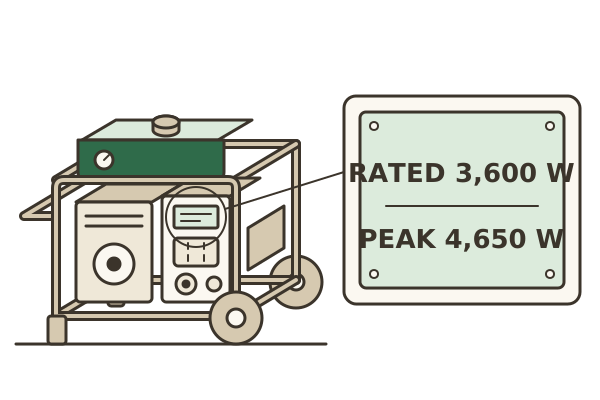
- Generac: starting (peak or surge) watts are the extra watts a generator can provide momentarily to turn on an appliance. Its GP8000E produces 8,000 watts of continuous power and up to 10,000 watts of starting power.
- WEN: rated power is what a generator can provide continuously; surge power is what it can provide for a short time, usually a couple of seconds, and is always higher.
- Honda: the EU2200i is 2,200 W maximum and 1,800 W rated.
- Cummins: pick a generator whose surge rating exceeds your starting total and whose running rating exceeds your running total.
Listings often lead with the bigger, peak number. On the 14 generators we verified against maker spec sheets, the rated figure is 75 to 82 percent of the peak figure, so a "5,000 watt" generator may be rated for well under 5,000. Some listings also reuse a sister model's number: on the Westinghouse WGen14500DFc, 14,500 is the running figure, not the peak.
Each outlet has its own limit. Generac: a 120 V, 20 A outlet carries 2,400 W and a 120/240 V, 30 A outlet 7,200 W, and breakers protect their own outlets, not the whole generator. Fuel matters too: Champion says propane typically delivers about 10 percent less than gasoline.
See what will a generator run for both numbers worked out at every common size.
07 Questions
Running and starting watts questions
What are running watts?
Running watts, also called rated watts, are the steady power an appliance draws while it runs. Briggs and Stratton describes them as the continuous watts needed to keep items running. On a generator, the rated (running) figure is what it can supply continuously.
What are starting watts?
Starting watts are the extra burst a motor-driven item needs to start. Briggs and Stratton says the burst lasts two to three seconds; Champion says a fraction of a second. On a generator, the starting (peak) figure is the most it can give for that short moment.
Are surge watts the same as starting watts?
Yes. Generac uses starting, peak and surge watts for the same thing: the extra watts a generator can provide for a moment to turn on an appliance.
Which appliances need starting watts?
Only motor-driven items, says Briggs and Stratton. Cummins names air conditioners, sump pumps, refrigerators and power tools. Heating loads such as toasters, coffee makers, space heaters and bulbs have no starting surge.
Why add only the largest starting surge?
Because in most cases only one item starts or cycles at a time, which Briggs and Stratton calls the most accurate estimate. Champion, Generac, Cummins and Westinghouse use the same rule. If two big motors could start together, add both surges, or start them one at a time.
How many more watts does a motor need to start?
It varies by source and by motor. Champion says starting watts are typically 1 to 2 times running watts, Generac often 2 to 3 times, and Cummins says some loads can need 3, 4 or even 5 times. Our chart lists each item’s own figure; your appliance’s label beats any rule of thumb.
What if my appliance lists only amps or only running watts?
Watts equal volts times amps, so a 120 V item drawing 10 amps uses 1,200 watts (Briggs and Stratton, Generac). If no surge is listed, WEN says to multiply the wattage rating by 3. For an air conditioner, Cummins says the starting power or locked rotor amps (LRA) are often printed on the condenser’s data tag.
Which generator number do I compare with my total?
Both. Cummins says the generator’s surge rating must exceed your starting total and its running rating must exceed your running total. Match your running total plus 20 percent to the rated watts and your starting total plus 20 percent to the peak watts.
Does a soft starter let me use a smaller generator?
Often, for an air conditioner. Generac says its soft starter reduces the in-rush current at startup by up to 70 percent, and DuroMax says that with a soft start a 5 ton AC that takes about 6,000 watts to run can be served by a 10,000 to 12,000 watt generator.
Do propane, altitude and heat change the watts a generator makes?
Yes. Champion says propane typically delivers about 10 percent less than gasoline and natural gas 10 to 15 percent less. Honda, Champion and Westinghouse manuals say output drops about 3.5 percent per 1,000 feet of elevation, and Westinghouse about 1 percent for each 10 F above 60 F.
Sources: Briggs and Stratton, Cummins, Generac on power limits, Generac on soft starters, DuroMax, Champion, Honda, Westinghouse, WEN and DTE Energy (each on the wattage chart). All read October 17, 2026.