Buying guide Power stations
Best solar generator for home backup: power stations by size
A "solar generator" is a battery power station: a battery, an inverter and outlets, charged from the wall or a solar panel, with no fuel and no exhaust. For a refrigerator, a router and a few lights, a 1 to 2 kWh unit covers the start and runs for a few hours; a well pump or central air is usually beyond it.
Size it with two numbers: watts, from the same rule as our calculator, and watt-hours, for how long it lasts.
Watts and watt-hours: the two numbers to check
A power station has to cover your watts (its rated output for the running total, its surge rating for the start) and hold enough watt-hours for the hours you need. Jackery puts it plainly: watts measure the power a device takes to run, and a watt-hour is one watt for one hour, so a 70 watt bulb on for an hour uses 70 Wh.
- Size the watts the same way as a generator: running total, plus the single largest starting surge, plus 20 percent headroom. The calculator does this for you.
- Check both outputs. Jackery says the load should be less than the power station's rated wattage, and to check the surge rating too. Your running number goes against the rated output, your starting number against the surge.
- Work out the hours. Jackery's formula: hours = capacity in Wh x 0.85 / the watts your devices draw. The 0.85 covers the power lost in conversion.
- Or work out the capacity. Turn it around: Wh needed = watts x hours / 0.85.
The 0.85 is Jackery's factor. We use it for every brand so the numbers compare; other makers may use their own. Jackery also calls its runtimes a reference, not a promise, and so do we.
What size power station do I need? Worked examples
A refrigerator alone needs a power station rated for about 400 W with 1,200 W of surge, and about 4,000 Wh to run it nonstop for 12 hours. The table works five common lists with our typical figures and Jackery's formula, on four of the power stations we list.
| What you run | Draw | Needs rated / surge | 1,070 Wh | 2,042 Wh | 3,072 Wh | 5,040 Wh |
|---|---|---|---|---|---|---|
| Refrigerator | 280 W | 400 / 1,200 W | 3.2 h | 6.2 h | 9.3 h | 15.3 h |
| Refrigerator, router, 4 LED bulbs, 2 phone chargers | 500 W | 600 / 1,500 W | 1.8 h | 3.5 h | 5.2 h | 8.6 h |
| The same, plus a chest freezer | 800 W | 1,000 / 1,900 W | 1.1 h | 2.2 h | 3.3 h | 5.4 h |
| 1 hp well pump most run on 230 V | 1,500 W | 1,800 / 3,600 W | Too small | 120 V only | 120 V only | 2.9 h of pumping |
| 3 ton central AC Champion's figures | 3,250 W | 3,900 / 6,600 W | Too small | Too small | Too small | 1.3 h |
Columns are the Jackery Explorer 1000 v2 (1,070 Wh, 1,500 W rated, 3,000 W surge), Jackery Explorer 2000 v2 (2,042 Wh, 2,200 / 4,400 W), EcoFlow DELTA 3 Ultra (3,072 Wh, 3,600 / 7,200 W, 120 V) and Jackery Explorer 5000 Plus (5,040 Wh, 7,200 / 14,400 W, 120/240 V). "Too small" means the rated or surge output is below the need.
How the second row works: the refrigerator (280 W), router (20 W), four LED bulbs (80 W) and two phone chargers (120 W) draw 500 W. The refrigerator's 720 W start is the only surge, so the starting total is 1,220 W. With 20 percent headroom you need 600 W rated and 1,500 W of surge. Hours on the Explorer 1000 v2: 1,070 x 0.85 / 500 = 1.8. To run that list for 8 hours you would need 500 x 8 / 0.85, about 4,700 Wh.
These hours assume every item draws its running watts the whole time. If your refrigerator's compressor is not running nonstop, the hours stretch: in Consumer Reports' 2019 tests, the power stations ran a side-by-side refrigerator from 13 hours (the worst) to 44 hours (the best). For your own refrigerator, use the yearly energy figure on its yellow EnergyGuide label (the FTC says the label shows how much energy an appliance uses compared with similar models; FTC, EnergyGuide label): divide it by 365 for a daily figure in kWh, then divide your power station's usable watt-hours by that number for an estimate of days
The well pump row uses the Champion chart's typical 1 hp figures; most submersible well pumps run on 230 V (Oakville Water Services), which only the Explorer 5000 Plus here supplies. The central AC row uses Champion's 3 ton figures, but Generac says a 3 ton unit can demand 15 to 18 kW to start, more than any surge rating we list. See refrigerator watts for every fridge type.
What a power station can run, and what it usually cannot
A 1 kWh or larger power station starts and runs a typical refrigerator. A well pump or central air is usually beyond it, though the sources disagree on smaller pumps.
Usually yes
- Refrigerator: typically 280 W running and 1,000 W to start (Champion chart). The 1 to 2 kWh units we list have 2,400 to 3,000 W of surge.
- Lights, router, phones, laptop, TV: small loads with no start surge in our chart.
- Microwave: about 900 W, so 1,100 W rated with headroom. That rules out the 600 W BLUETTI Elite 30 V2 but not the 1 kWh class.
- Space heater: about 1,130 W, so 1,400 W rated. It fits a 1 kWh unit but drains it fast: 1,070 x 0.85 / 1,130 is about 0.8 hours.
Usually no
- Well pump: Consumer Reports (2019) says you will not be able to run a power-guzzling well pump. Jackery disagrees for smaller pumps: it says its Explorer 1000 Plus runs a 900 W well pump about 1.2 hours, and its 2000 Plus kit runs 2,000 to 3,000 W pumps for 1.1 to 1.7 hours.
- Central air: no source we read says a portable power station can or cannot run it. On the numbers, a 3 ton unit needs 3,000 to 3,500 W running and 5,000 to 6,000 W to start (Champion), or up to 15 to 18 kW (Generac).
- Anything hard-wired: a furnace, well pump or central AC is wired into the panel. Consumer Reports says hard-wired items need a transfer switch with a power station just as with a gas generator, installed by a licensed electrician.

Picks By capacity
Power stations for home backup by capacity
Pick the tier from the watt-hours you worked out, then check the rated and surge output against your two numbers. Every spec here is the maker's.
As an Amazon Associate, we earn from qualifying purchases.
Under 1 kWh: phones, router, lights
For small loads and short outages. Not for a microwave, space heater or sump pump.
BLUETTI Elite 30 V2
288 Wh at 9.48 lb for phones, a router, a laptop and lights, with no fumes indoors.
- Capacity
- 288 Wh
- AC output
- 600 W rated (no surge figure quoted)
- Outlets
- 9 outlets in total (AC count not confirmed on the page read)
- Noise
- 30 dB, maker figure
- Weight
- 9.48 lb
- Listing
- Same model as the maker page
Not a fit for: anything over 600 W running, such as a space heater, microwave or sump pump. BLUETTI's 1,500 W "Lifting Power" is a mode for heating loads, not a surge rating, so it is no guide to starting a refrigerator.
Find it on Amazon (opens Amazon in a new tab)
The under 1 kWh search leads with lesser-known brands. Check the maker's watt-hours and rated output before you buy.
1 to 2 kWh: a refrigerator for a few hours
Enough surge for a typical refrigerator start, indoors, with no fumes.
Jackery Explorer 1000 v2
1,070 Wh at 23.8 lb, with a 3,000 W surge rating that covers a typical refrigerator start.
- Capacity
- 1,070 Wh
- AC output
- 1,500 W rated, 3,000 W surge
- Outlets
- three 120V AC, USB-C, USB-A, car outlet
- Refrigerator at 280 W
- about 3.2 h (Jackery's formula)
- Weight
- 23.8 lb
- Listing
- Same model as the maker page
Not a fit for: 240 V loads; well pumps; central AC; multi-day outages without recharging.
Find it on Amazon (opens Amazon in a new tab)Anker SOLIX C1000
Six AC outlets and 1,800 W rated output; grows to 2,112 Wh with the BP1000 battery.
- Capacity
- 1,056 Wh
- AC output
- 1,800 W rated, 2,400 W surge
- Outlets
- 6 AC, 2 USB-A, 2 USB-C, car outlet
- Expands
- to 2,112 Wh with the BP1000 battery
- Refrigerator at 280 W
- about 3.2 h (Jackery's formula)
- Weight
- 28.44 lb
- Listing
- Same model as the maker page
Not a fit for: 240 V loads; well pumps; central AC.
Find it on Amazon (opens Amazon in a new tab)
2 to 4 kWh: essentials through an evening
More watt-hours for 120 V essentials; check the rated output against your running total.
Jackery Explorer 2000 v2
2,042 Wh with 2,200 W rated output (4,400 W surge) at 39.5 lb.
- Capacity
- 2,042 Wh
- AC output
- 2,200 W rated, 4,400 W surge
- Outlets
- three 120V AC (18.3A), USB-C, USB-A
- Refrigerator at 280 W
- about 6.2 h (Jackery's formula)
- Weight
- 39.5 lb
- Listing
- Same model as the maker page
Not a fit for: 240 V loads; transfer switch hookup (no 30 A outlet listed).
Find it on Amazon (opens Amazon in a new tab)EcoFlow DELTA 3 Ultra
3,072 Wh with a 30 A AC outlet; grows to 11 kWh with extra batteries.
- Capacity
- 3,072 Wh
- AC output
- 3,600 W rated, 7,200 W surge
- Outlets
- 120V AC: four 20A outlets and one 30A outlet
- Expands
- to 11 kWh with two DELTA Pro 3 Extra Batteries
- Refrigerator at 280 W
- about 9.3 h (Jackery's formula)
- Weight
- 72.1 lb
- Listing
- Same model as the maker page
Not a fit for: 240 V loads (120 V output listed).
Find it on Amazon (opens Amazon in a new tab)
4 kWh and up, expandable: a night, or 240 V
Systems that grow with extra batteries. The class search mixes in smaller units, so check the capacity on each listing.
Jackery Explorer 5000 Plus
5,040 Wh with 120/240 V output and a 30 A outlet that can feed a transfer switch: the only 240 V unit we list.
- Capacity
- 5,040 Wh
- AC output
- 7,200 W rated, 14,400 W surge
- Outlets
- four 120V 20A, one L14-30R/14-50 120/240V 30A
- Expands
- to 60 kWh (2 units plus 10 expansion packs, maker)
- Refrigerator at 280 W
- about 15.3 h (Jackery's formula)
- Weight
- 134.5 lb
- Listing
- Same model as the maker page
Not a fit for: carrying by hand (about 134.5 lb); a full 50 A RV draw (the 240 V outlet is rated 30 A).
Find it on Amazon (opens Amazon in a new tab)EcoFlow DELTA Pro
3,600 Wh on its own, growing to 25 kWh with extra batteries and a second unit.
- Capacity
- 3,600 Wh
- AC output
- 3,600 W rated (no surge figure quoted)
- Outlets
- AC outlets (US count not confirmed on the page read)
- Expands
- 3.6 to 25 kWh with Smart Extra Batteries and a second unit
- Refrigerator at 280 W
- about 10.9 h on one unit (Jackery's formula)
- Weight
- 99 lb
- Listing
- Same model as the maker page
Not a fit for: buyers who need 240 V from a single unit (not confirmed on the page read).
Find it on Amazon (opens Amazon in a new tab)
Power stations burn no fuel and give off no exhaust, so a CO shutoff does not apply to them.
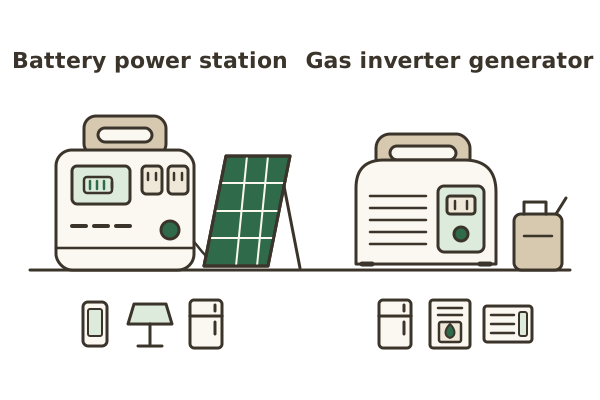
Power station or gas generator for an outage?
A power station is the quiet, indoor-safe choice for small loads; a gas generator makes more power for longer and refuels from a can.
Battery power station
- Consumer Reports calls power stations the only type of generator that can be used indoors safely: no fumes, and the models it tested made virtually no noise.
- When the battery is empty and there is no sun for the panels, you cannot recharge it. You cannot just add another gallon of gas (Consumer Reports).
- In Consumer Reports' 2019 tests, a TV and a few lights ran 3 to 9 hours on a power station.
- Recharge time varies a lot: EcoFlow says its DELTA 3 Plus charges fully in 56 minutes from a 1,500 W wall input, while Consumer Reports found in 2019 that most models needed hours, typically overnight, and that solar added an hour or two of power with larger appliances.
Gas generator
- WEN says generators are usually less expensive per watt than power stations and often make more power overall, with added weight, maintenance, noise and emissions.
- In the same 2019 tests, a recreational inverter ran a TV and a few lights 8 to 13 hours on one tank of gas.
- It must run outside, at least 20 feet from the house, with the exhaust pointed away (CPSC).
- Our quietest generators guide and the portable generator buying guide have the picks.
You can also use both: a power station indoors for the refrigerator, router and lights, and a generator outside for the heavier loads. Size each with the calculator.
How we choose power stations
We sort picks by watt-hours, the number that decides how long a power station lasts, and show the rated and surge output from the maker's own page beside it. We do not test power stations; each Amazon listing was matched by title, brand and model on October 17, 2026. Every tier has a search link so a sold-out model never leaves you at a dead end. We leave out unbranded units whose specs we could not check, prices, star ratings and badges.
Power station questions
What size power station do I need?
Two numbers decide it. Watts: add the running watts of what you will run at once, add the largest starting surge, add 20 percent, and check those against the rated and surge output. Watt-hours: multiply the watts your devices draw by the hours you need and divide by 0.85 (Jackery's formula). A refrigerator alone needs about 400 W rated, 1,200 W of surge and about 4,000 Wh for 12 hours of nonstop running.
What is the best solar generator for home backup?
The one that covers your watts and lasts the hours you need. For a refrigerator, router and lights over a few hours, a 1 to 2 kWh unit such as the Jackery Explorer 1000 v2 (1,070 Wh, 1,500 W rated, 3,000 W surge) does it. For a night of essentials or a 240 V load, look at 4 kWh and up; the Jackery Explorer 5000 Plus is the only 120/240 V unit we list.
Is a power station or a generator better for a power outage?
For small loads indoors, a power station: Consumer Reports calls it the only type of generator that can be used indoors safely. For heavier loads or a long outage, a gas generator: WEN says generators usually cost less per watt and make more power, and they refuel from a can, while a power station needs the grid or sun to recharge.
Can a power station run a refrigerator?
Yes, if it has the surge. A typical refrigerator runs at 280 W and needs about 1,000 W to start (Champion chart), so look for about 400 W rated and 1,200 W of surge with headroom. By Jackery's formula, a 1,070 Wh unit runs 280 W for about 3.2 hours nonstop; a compressor that cycles stretches that.
Can a power station run a well pump?
Usually not, and the sources disagree. Consumer Reports (2019) says you will not be able to run a power-guzzling well pump. Jackery says its Explorer 1000 Plus runs a 900 W well pump about 1.2 hours. Most submersible well pumps run on 230 V (Oakville Water Services), so you would need a 120/240 V unit, and a hard-wired pump needs a transfer switch installed by a licensed electrician.
Can a power station run central air?
No source we read says it can or cannot. Champion lists a 3 ton central AC at 3,000 to 3,500 W running and 5,000 to 6,000 W starting, and Generac says a 3 ton unit can demand 15 to 18 kW to start. Even on Champion's figures, the largest unit we list (5,040 Wh) would run it about 1.3 hours.
How long will a power station run?
Use Jackery's formula: capacity in Wh x 0.85 / the watts your devices draw. A 2,042 Wh unit running 500 W lasts about 3.5 hours. Jackery calls its runtimes a reference, and real draw changes as devices cycle on and off.
Can I use a power station indoors?
Yes. Consumer Reports says power stations are the only type of generator that can be used indoors safely, because they make no fumes. A gas generator, inverter or not, must run outside, at least 20 feet from the house (CPSC).
How fast does a power station recharge?
It depends on the model and the charger. EcoFlow says its DELTA 3 Plus charges fully in 56 minutes from a 1,500 W wall input. Consumer Reports found in 2019 that most models it tested needed hours, typically overnight, and that solar added only an hour or two of power with larger appliances; those tests predate the fastest chargers.
How many years does a power station battery last?
Makers rate it in charge cycles. EcoFlow rates its DELTA 3 Plus at 4,000 cycles to 80 percent capacity and up to 10 years, and Jackery rates its Explorer 1000 Plus at 4,000 cycles and 10 or more years, both with LiFePO4 batteries. EcoFlow's own comparison puts LiFePO4 at 3,000 to 6,000 or more cycles and NMC at 500 to 2,000.
Sources: Jackery on watt-hours, Jackery on well pumps, Consumer Reports on power stations (2019), EcoFlow DELTA 3 Plus, EcoFlow on LiFePO4 and NMC, WEN, Champion wattage chart, Generac, Oakville Water Services. Product specs from each maker's page. All read October 17, 2026.