By situation RV and camper
What size generator do I need for my RV?
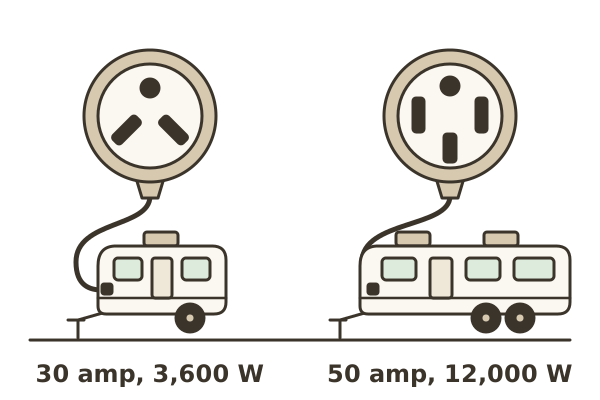
A 30 amp RV can draw at most 3,600 watts and a 50 amp RV at most 12,000 watts, because a 30 amp shore cord is rated at 120 V and a 50 amp cord at 240 V (Cummins). Our typical 30 amp list, one 13,500 BTU air conditioner with the fridge, microwave, lights and TV, needs a generator rated for at least 4,200 running and 5,900 starting watts, with a TT-30R outlet.
The air conditioner's start is the number that decides it. A generator that runs everything else can still fail to start the AC.

01 Size yours
Which shore power does your RV have?
Your generator size
Sized for RV 30 amp (10 items)
Your generator needs at least
5,900 starting watts
and about 4,200 running watts
Portable fits
A mid-size portable or mid-size inverter generator covers this.
Class: Mid-size portable (4,000 to 7,000 W) or mid-size inverter (3,000 to 4,500 W)
As an Amazon Associate, we earn from qualifying purchases.
Shore cord limit: a 30 amp RV shore cord is rated at 120 V, so it carries at most 3,600 watts (Cummins). Your list runs at 3,470 W before headroom, inside that limit. These picks have the TT-30R outlet the cord plugs into.
Verified picks for this size
Westinghouse WGen5300DFcv
Covers your 4,200 running and 5,900 starting watts
Fits both a 30 A home hookup (L14-30R) and an RV TT-30 plug, with a CO sensor shutoff.
5,300 W running · 6,500 W peak · gas or propane · 120/240 V
Find it on Amazon (opens Amazon in a new tab)WEN DF680iX
Covers your 4,200 running and 5,900 starting watts
A dual fuel inverter with both an L14-30R and an RV TT-30R, plus a CO shutoff (CO Watchdog).
5,100 W running · 6,800 W peak · gas or propane · 120/240 V
Find it on Amazon (opens Amazon in a new tab)
All our verified picks for this size, with specs
On any listing, check two numbers: at least 4,200 running watts and 5,900 starting (peak) watts. Listings often lead with the peak figure.
Run it outside only, at least 20 feet from homes, exhaust pointed away (CPSC).
Show the math
- Running total: 3,470 W
- Largest single starting surge: 1,400 W (RV AC 13,500 BTU)
- Starting total: 3,470 + 1,400 = 4,870 W
- Plus 20 percent headroom: 4,164 W running, 5,844 W starting
- Rounded up to the next 100: 4,200 W running, 5,900 W starting
Typical figures; check your appliance's labels. Every list can be edited in the full calculator.
The 30 amp list is one 13,500 BTU air conditioner, the RV refrigerator, a microwave, 4 LED bulbs, a TV and 2 phone chargers. The 50 amp list has two air conditioners, the refrigerator, a microwave, the electric water heater, a TV and 6 bulbs.
02 30 amp or 50 amp
30 amp vs 50 amp RV: 3,600 watts or 12,000 watts
The shore plug sets the ceiling. Cummins: "A 30-amp shore cord is rated at 120 V. Therefore, the max total power available is 3,600 watts," and "a 50-amp shore cord is rated at 240 V. The total max power available here is 12,000 watts." Cummins adds that the power you actually get depends on the RV's own breakers and wiring.
| Service | Plug | Most it carries | Generator to match all of it (Cummins) | Our typical list needs |
|---|---|---|---|---|
| 30 amp, 120 V | TT-30 | 3,600 W | Rated for 3,600 W at a minimum | 4,200 / 5,900 W |
| 50 amp, 240 V | 14-50 | 12,000 W | Rated at 12,000 W | 7,800 / 9,500 W |
Why our 30 amp number is above 3,600: the cord caps what the RV can pull, and our list runs at 3,470 W, inside that cap. The extra 20 percent is headroom on the generator, so it is not running flat out, plus room for the air conditioner's start. It is not extra power into the RV.
- One outlet, one limit. Generac says each outlet has its own cap and its breaker protects that outlet, not the whole generator. An RV that needs 7,500 W cannot run from one 30 A, 240 V outlet (7,200 W) even on an 8,000 W generator.
- A 25 amp TT-30R. Champion rates the TT-30R on its 4000 W RV Ready inverter at 25 A, so it does not deliver a full 30 amps.
03 Worked examples
RV generator sizes for five real lists
A light 30 amp list needs 2,200 running and 3,000 starting watts, a typical 30 amp list 4,200 and 5,900, and a typical 50 amp list with two air conditioners 7,800 and 9,500. Each uses the calculator's rule: running total, plus the single largest surge (always the air conditioner here), plus 20 percent headroom, rounded up to the next 100.
| List | Running total | Largest surge | Starting total | You need (running / starting) |
|---|---|---|---|---|
| Light 30 amp: 11,000 BTU AC, RV refrigerator, 4 LED bulbs, TV, 2 phone chargers | 1,830 W | 590 W | 2,420 W | 2,200 / 3,000 W |
| One 13,500 BTU AC and the RV refrigerator | 2,130 W | 1,400 W | 3,530 W | 2,600 / 4,300 W |
| 15,000 BTU AC, RV refrigerator, TV, 4 LED bulbs | 2,950 W | 1,750 W | 4,700 W | 3,600 / 5,700 W |
| Typical 30 amp (the calculator's preset): 13,500 BTU AC, RV refrigerator, microwave, 4 LED bulbs, TV, 2 phone chargers | 3,470 W | 1,400 W | 4,870 W | 4,200 / 5,900 W |
| Typical 50 amp (the calculator's preset): two 13,500 BTU ACs, RV refrigerator, microwave, electric water heater, TV, 6 LED bulbs | 6,490 W | 1,400 W | 7,890 W | 7,800 / 9,500 W |
The typical 30 amp list in full: 1,750 + 380 + 900 + 80 + 240 + 120 = 3,470 W running. The AC's surge is its 3,150 starting minus its 1,750 running, 1,400 W, so the starting total is 4,870 W. Times 1.2 that is 4,164 running and 5,844 starting, which rounds up to 4,200 running and 5,900 starting watts. Only one surge counts because only one motor usually starts at a time (Briggs and Stratton); on the 50 amp list that assumes the two ACs do not start at the same moment.
Typical figures from the Champion wattage chart and the Westinghouse manual (11,000 BTU AC); check your appliance's labels. The full wattage chart lists every RV load with every source.
04 RV air conditioners
RV air conditioner watts: 1,010 to 2,250 running, 1,600 to 4,000 to start
A rooftop RV air conditioner typically runs at 1,010 to 2,250 watts depending on size, and needs 1,600 to 4,000 watts for a few seconds to start. That start is the biggest single number on almost every RV list.
| Load and source | Running W | Starting W |
|---|---|---|
| RV AC 11,000 BTU Westinghouse manual. Range in our sources: running 1,010 W, starting 1,600 W (2 sources) | 1,010 | 1,600 |
| RV AC 13,500 BTU Champion wattage chart. Range in our sources: running 1,500 to 2,000 W, starting 2,800 to 3,500 W (3 sources) | 1,750 | 3,150 |
| RV AC 15,000 BTU Champion wattage chart. Range in our sources: running 2,000 to 2,500 W, starting 3,300 to 4,500 W (2 sources) | 2,250 | 4,000 |
| RV refrigerator Champion wattage chart. Range in our sources: running 150 to 600 W, starting 400 to 1,000 W (3 sources) | 380 | 700 |
| RV microwave Champion wattage chart: 600 to 1,200 W running, no starting surge listed | 900 | 900 |
| RV water heater (electric element) Champion wattage chart: 1,200 to 1,500 W running, no starting surge listed | 1,350 | 1,350 |
| RV converter Cummins RV guide: 500 to 1,000 W (4 to 8 amps at 120 V), no surge figure | 750 | 750 |
Typical = the midpoint of the source's range, rounded up to the nearest 10 W. The best number is on your AC's data tag: Cummins says the starting power or the starting current (locked rotor amps, LRA) is often printed there.
Soft start kits
A soft starter cuts the burst of current a compressor draws to start. Generac says its SureStart reduces in-rush current at startup by up to 70 percent on air conditioners and heat pumps from 1.5 to 7 horsepower, and DuroMax says that with a soft start you will not need an oversized generator to handle the startup surge. Those figures are for home units; we have not read an RV soft start maker's own figure for a rooftop unit, so every number on this page assumes no soft start. Treat one as extra margin, not as a reason to buy a smaller generator. The running vs starting watts page explains the surge.
As an Amazon Associate, we earn from qualifying purchases.
See all RV soft start kits on Amazon (opens Amazon in a new tab)05 Parallel kits
Parallel kits: two small inverters as one bigger generator
A parallel kit joins two inverter generators of the same brand so their output adds up. Honda says two identical EU2200i units "can be paralleled with an optional cable for up to 4400 watts of power"; each is rated 1,800 W running, so the pair is 3,600 W running.
- Light 30 amp list (2,200 / 3,000 W): one EU2200i (1,800 / 2,200 W) is short; the pair covers it.
- One 13,500 BTU AC and the fridge (2,600 / 4,300 W): the pair (3,600 / 4,400 W) covers it, just.
- Typical 30 amp list (4,200 / 5,900 W): the pair is short on both numbers. That list needs one larger generator.
Kits are brand-specific: a Champion kit links Champion inverters and a WEN kit links WEN inverters. Consumer Reports notes you can pair most small inverters to increase output. Both kits below have a 14-50R and an L5-30R outlet.
Champion 50A ParaLINK Parallel Kit (100319)
Links two Champion inverters of 2,800 W or larger, with an RV 14-50R (120 V, 50 A) and an L5-30R outlet with breakers.
- Fits
- Two parallel-capable Champion inverters, 2,800 W or larger
- Outlets
- 120V 50A RV (14-50R), 120V 30A locking (L5-30R)
- Listing
- Brand and specs match; confirm the model number on the listing
Not a fit for: other brands; open frame generators.
Find it on Amazon (opens Amazon in a new tab)WEN GNA50i 50-Amp Parallel Kit
Up to 50 A and 6,000 W from two WEN inverters, with a 14-50R and an L5-30R outlet and a 7 ft reach.
- Fits
- Two parallel-capable WEN inverters (check WEN's compatibility list)
- Outlets
- 14-50R 50A 120V, L5-30R 30A 120V
- Listing
- Same model as the maker page
Not a fit for: other brands; 240 V output (WEN sells a separate 240 V kit we have not checked).
Find it on Amazon (opens Amazon in a new tab)
06 Quiet hours
Quiet hours and decibels: what the numbers mean at 23 feet
Manufacturers commonly publish noise at 23 feet (7 meters), and normal conversation is 60 to 70 dBA (NIH). Champion says its 3,400 W RV Ready inverter runs at 59 dBA from 23 feet, "about the same noise level as normal conversation."
NIH adds that sounds at or below 70 dBA are unlikely to cause hearing loss even after long exposure. Makers do not all measure the same way, so the figures below are not comparable as given: read each one with its distance and load. Before you buy, check your campground's generator hours and noise rules.
| Model | Maker's noise figure | Outlet for the RV |
|---|---|---|
| Honda EU2200i (pair with a kit) | 48 to 57 dB(A), quarter load to rated load | None; needs an adapter |
| Westinghouse iGen5000DFc | 52 dBA | TT-30R |
| Champion 4000-Watt RV Ready Inverter | 64 dBA at 23 ft | TT-30R, rated 25 A |
| WEN DF680iX | 64 dB at quarter load | TT-30R |
| Westinghouse WGen3600DFc and WGen5300DFcv | 68 dBA | TT-30R |
| Westinghouse WGen9500DFc, DuroMax XP13000EH, Westinghouse WGen14500DFc | 74 dBA, 74 dB, and as low as 74 dBA | 14-50R |
For campsite-first picks ranked by published noise, see the quietest generators guide.
07 Picks
RV-ready generators, by plug
These are the models whose maker pages confirm a TT-30R (30 amp) or a 14-50R (50 amp) outlet. For a typical 30 amp list, the WEN DF680iX and Westinghouse WGen5300DFcv clear 4,200 running and 5,900 starting watts; for a typical 50 amp list, all three 14-50R models clear 7,800 and 9,500.
As an Amazon Associate, we earn from qualifying purchases.
30 amp RV (TT-30R)
WEN DF680iX
Covers the typical 30 amp list on gas or propane, with a TT-30R and a CO shutoff (CO Watchdog).
- Running / peak
- 5,100 / 6,800 W on gas
- On propane
- 4,500 / 6,000 W
- Outlets
- 120/240V L14-30R, two 120V 5-20R, 120V TT-30R (RV), 12V DC, two 5V USB
- CO shutoff
- Yes (CO Watchdog)
- Noise
- 64 dB at quarter load, maker figure
- Listing
- Same model as the maker page
Not a fit for: a 50 A RV plug.
Find it on Amazon (opens Amazon in a new tab)Westinghouse WGen5300DFcv
Covers the typical 30 amp list on gas. On propane its 5,800 W peak is just under the list's 5,900.
- Running / peak
- 5,300 / 6,500 W on gas
- On propane
- 4,800 / 5,800 W
- Outlets
- 120V duplex 5-20R, 120/240V L14-30R, 120V TT-30R (RV)
- CO shutoff
- Yes
- Weight
- 135.6 lb
- Noise
- 68 dBA, maker figure
- Listing
- Brand and specs match; confirm the model number on the listing
Not a fit for: a 50 A RV plug or a 50 A home hookup; whole-house backup.
Find it on Amazon (opens Amazon in a new tab)Westinghouse iGen5000DFc
Covers one 13,500 BTU AC with the fridge (2,600 / 4,300 W), not the full typical 30 amp list.
- Running / peak
- 3,900 / 5,000 W on gas
- On propane
- 3,500 / 4,500 W
- Outlets
- 120V duplex 5-20R, 120V TT-30R (RV), 2 USB
- CO shutoff
- Yes
- Weight
- 105.8 lb
- Noise
- 52 dBA, maker figure
- Listing
- Brand and specs match; confirm the model number on the listing
Not a fit for: 240 V loads or a 240 V home hookup (120 V only).
Find it on Amazon (opens Amazon in a new tab)Westinghouse WGen3600DFc
Covers one 13,500 BTU AC with the fridge on gas (3,600 / 4,650 W against 2,600 / 4,300).
- Running / peak
- 3,600 / 4,650 W on gas
- On propane
- 3,240 / 4,180 W
- Outlets
- 120V duplex 5-20R, 120V L5-30R, 120V TT-30R (RV)
- CO shutoff
- Yes
- Weight
- 121.1 lb
- Noise
- 68 dBA, maker figure
- Listing
- Brand and specs match; confirm the model number on the listing
Not a fit for: any 240 V load or home hookup (no L14-30R).
Find it on Amazon (opens Amazon in a new tab)Champion 4000-Watt RV Ready Inverter
Covers the light 30 amp list (2,200 / 3,000 W) or a 13,500 BTU AC on its own (2,100 / 3,800 W), and it can run in parallel.
- Running / peak
- 3,000 / 4,000 W, gas
- Outlets
- 120V TT-30R rated 25 A (RV), 120V 20A duplex 5-20R, 12V, parallel outlets
- CO shutoff
- Yes (CO Shield)
- Weight
- Under 49 lb
- Noise
- 64 dBA at 23 ft, maker figure
- Listing
- Brand and specs match; the listing does not show which of Champion's two 4000 W models (201419 or 100809) it is
Not a fit for: 240 V loads; a full 30 A draw (its TT-30R is rated 25 A).
Find it on Amazon (opens Amazon in a new tab)
50 amp RV (14-50R)
Westinghouse WGen9500DFc
Covers the typical 50 amp list (7,800 / 9,500 W) on gas or propane, with a 14-50R.
- Running / peak
- 9,500 / 12,500 W on gas
- On propane
- 8,500 / 11,200 W
- Outlets
- two 120V GFCI 5-20R, 120/240V L14-30R, 120/240V 14-50R (50A)
- CO shutoff
- Yes
- Weight
- 221 lb
- Noise
- 74 dBA, maker figure
- Listing
- Brand and specs match; confirm the model number on the listing
Not a fit for: a TT-30 RV plug without an adapter; carrying by hand.
Find it on Amazon (opens Amazon in a new tab)DuroMax XP13000EH
Covers the typical 50 amp list with room to spare: 10,500 running watts and both 30 A and 50 A outlets.
- Running / peak
- 10,500 / 13,000 W on gas
- On propane
- 10,000 / 12,500 W
- Outlets
- 120V 20A GFCI 5-20, 120V L5-30, 120/240V L14-30, 120/240V 14-50 (50A), 12V DC
- CO shutoff
- Yes, per the maker's spec table
- Weight
- 234 lb
- Noise
- 74 dB, maker figure
- Listing
- Same model as the maker page
Not a fit for: carrying by hand (234 lb dry); quiet campgrounds.
Find it on Amazon (opens Amazon in a new tab)Westinghouse WGen14500DFc
The only model we checked that covers a full 12,000 W, 50 amp service plus 20 percent headroom (14,400 running watts) on gas.
- Running / peak
- 14,500 / 18,000 W on gas
- On propane
- 13,000 / 16,000 W
- Outlets
- two 120V GFCI 5-20R, 120V 30A L5-30, 120/240V 30A L14-30R, 120/240V 50A 14-50R, 2 USB
- CO shutoff
- Yes
- Weight
- 352 lb (from the sister model page and the listing)
- Noise
- As low as 74 dBA, maker figure
- Listing
- Same model as the maker page
Not a fit for: moving by hand. Amazon titles it by its 18,000 W peak; a different listing titled "14500 Peak Watt" is a smaller model.
Find it on Amazon (opens Amazon in a new tab)
Cords
The RV's own shore cord plugs straight into a TT-30R or 14-50R on the generator. A 30 amp L14-30 cord is for the generator's 240 V outlet, the one that feeds a home inlet or transfer switch, not for the RV plug.
See all 30 amp generator cords on Amazon (opens Amazon in a new tab)Run it outside only, at least 20 feet from homes with the exhaust pointed away (CPSC), and away from your RV's doors, windows and vents. Never run it in a truck bed, SUV or trailer (Champion). Generator safety.
08 Questions
RV generator questions
What size generator do I need for a 30 amp RV?
At least 3,600 watts, the most a 30 amp, 120 V shore cord can carry (Cummins), and usually more to start the air conditioner. Our typical 30 amp list, a 13,500 BTU AC with the fridge, microwave, lights and TV, needs 4,200 running and 5,900 starting watts with 20 percent headroom, and a TT-30R outlet.
What size generator do I need for a 50 amp RV?
Cummins says a generator matching a full 50 amp service would have to be rated at 12,000 watts. Most lists use less: our typical 50 amp list, two 13,500 BTU ACs with the fridge, microwave, water heater, TV and lights, needs 7,800 running and 9,500 starting watts, and a 14-50R outlet.
How many watts does an RV air conditioner use?
Typically 1,010 running and 1,600 starting watts for an 11,000 BTU unit (Westinghouse), 1,750 and 3,150 for 13,500 BTU, and 2,250 and 4,000 for 15,000 BTU (Champion). Champion's own range for a 13,500 BTU unit is 1,500 to 2,000 running and 2,800 to 3,500 starting. Your unit's data tag has the real number.
Will a 2,200 watt inverter run an RV air conditioner?
An 11,000 BTU unit on its own, yes: it needs 1,300 running and 2,000 starting watts with headroom, inside a Honda EU2200i's 1,800 rated and 2,200 maximum watts. A 13,500 BTU unit, no: it needs 2,100 and 3,800. Two EU2200i in parallel give up to 4,400 watts (Honda), which covers it.
What size generator runs a 15,000 BTU RV air conditioner?
On its own, at least 2,700 running and 4,800 starting watts: 2,250 running plus its 1,750 W surge, plus 20 percent. With the RV fridge, a TV and 4 LED bulbs, 3,600 running and 5,700 starting watts.
Can I run two air conditioners on 30 amp shore power?
Not with much else. Two 13,500 BTU units run at about 3,500 W together (Champion, typical), and a 30 amp cord carries 3,600 W at most (Cummins), so the refrigerator alone would put you over. Two ACs plus the rest is what 50 amp service, at 12,000 W, has room for.
Do I need a soft start for my RV air conditioner?
Not if your generator covers the AC's full start, which is how we size every list here. A soft starter cuts the startup current (Generac says up to 70 percent on home units of 1.5 to 7 hp), but we have not read an RV soft start maker's figure for a rooftop unit, so treat one as extra margin rather than a reason to buy a smaller generator.
Can I parallel two generators for my RV?
Yes, with two parallel-capable inverters of the same brand and that brand's kit. Honda says two EU2200i give up to 4,400 watts. Champion's ParaLINK kit (100319) links two Champion inverters of 2,800 W or larger, and WEN's GNA50i gives up to 6,000 W from two WEN inverters; both kits have a 14-50R outlet.
What size generator do I need for a travel trailer or camper?
Look at the shore cord's plug first. A TT-30 plug is 30 amp service (3,600 W at most) and a 14-50 plug is 50 amp service (12,000 W at most), per Cummins. Then size what you run at once: one 13,500 BTU AC with the fridge needs 2,600 running and 4,300 starting watts; add a microwave, lights and a TV and it is 4,200 and 5,900.
How quiet should an RV generator be?
Quieter than conversation if you can: NIH puts normal conversation at 60 to 70 dBA, and Champion says its 3,400 W RV Ready inverter runs at 59 dBA from 23 feet. Makers measure differently, so compare figures only at the same distance and load, and check your campground's generator rules.
Sources: Cummins RV power basics, Cummins sizing, Champion wattage chart, Champion 3400 W RV Ready inverter, Westinghouse manual, Honda EU2200i, Generac on outlet limits, Generac on soft starters, DuroMax on soft starts, NIH NIDCD, CPSC. All read October 17, 2026.